
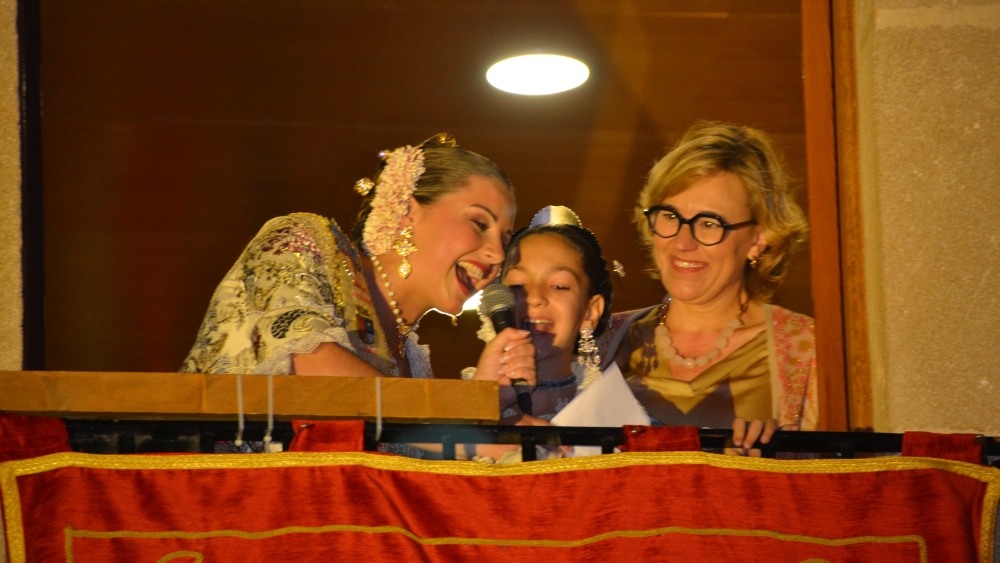
The Pregón – The Official Start of the Festivities
After the proclamations, there is often a sort of “phoney fiesta” for a few days before the ‘Pregón‘, the official announcement of the start of the festivities of the Fogueres de Sant Joan de Xàbia. However, the anticipation is palpable across the town as it prepares for the biggest party of the year and it’s not unusual to see groups of people carrying sofas and other furniture or shopping carts full of beer, soft drinks and maybe something stronger as they prepare their temporary homes – known as ‘casals’ – where they will effectively live for the next couple of weeks.
The anticipation reaches a crescendo as the day of the ‘pregón’ arrives – normally June 13th or 14th – and in the early evening, the ‘quintà’ and both courts of honour (senior and junior) who will be the main protagonists of the festivities and have already been presented the weekend prior, gather for the opening procession which will inform the town residents’ that fiesta is finally open them. It’s a long route, visiting all the neighbourhoods of the town, and they are dressed in their finest traditional clothing. It’s early June and the temperatures are already making it uncomfortable, especially for the young men who occasionally tug at their collars and the young women, some of whom struggle to breath comfortably beneath their tight corsets, whilst others wave fans expertly to try and cool themselves down. But they endure for this is what they’ve paid for; this is what they have been waiting for almost all their lives.
Meanwhile, many of the ‘penyas’ and non-affiliated individuals start to gather in the Plaza de la Iglesia to assure themselves of a prime spot for the forthcoming ceremony. Sometimes there is a DJ providing music to sing and dance to; in recent years there has been a strict cordon manned by local police officers who restrict the amount of alcohol that can be taken into the square. There have never been major problems with alcohol abuse but the authorities don’t take any chances and it doesn’t subdue the building excitement as the sun begins to drop behind the surrounding houses. The penyas are dressed in the own colours but there’s a huge sense of camaraderie and friends embrace, shake hands and speak excitedly about their plans for the next two weeks. As the time of the official start approaches, the noise increases and the more youthful jump together in anticipation. The different colours, the team colours, the swaying crowd, all reminiscent of the old football terraces .
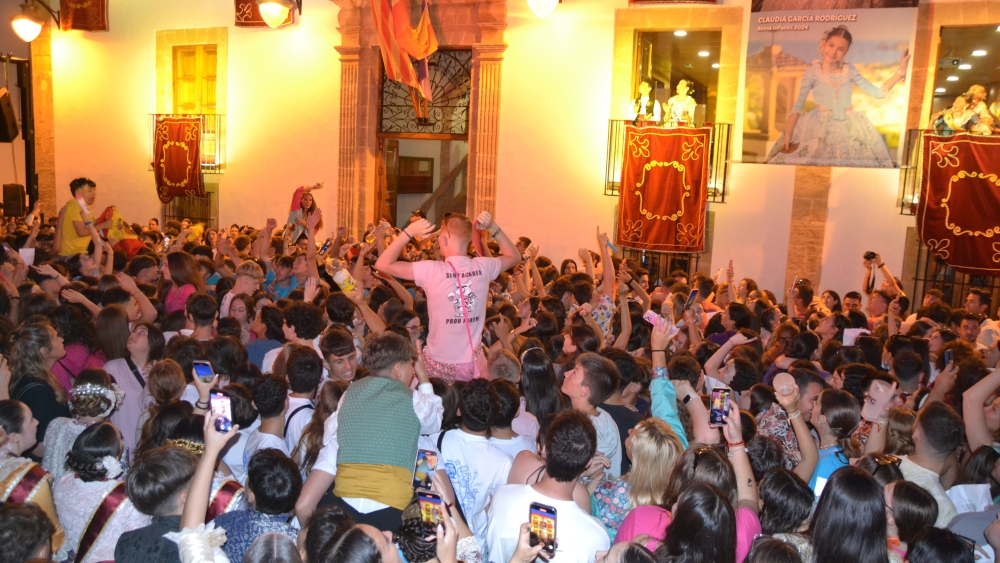
And then the procession arrives; the “home team” has arrived and a great cheer often welcomes them. There is an element of uncontrolled excitement as everyone waits for the formal speeches from the Fogueres Queen and the quintà presidents. Music fills the air as everyone begins to sing along to a few traditional fiesta tunes. Printed sheets are often handed out with the lyrics to two of the most popular songs, “Fogueres” and the stirring pasodoble of “Xàbia”. (see below).
And then, rarely on time, the officials appear on the balconies or on a temporary stage on the front of the town hall building and the announcement is read out: let the festivities begin! Fireworks burst into the air from the rooftops and quite often there are more fireworks and bursts of streamers and confetti launched from the church steps. The atmosphere in the square can be quite wild, almost unnerving for some, but it’s all conducted with fantastic goodwill.
The Singing
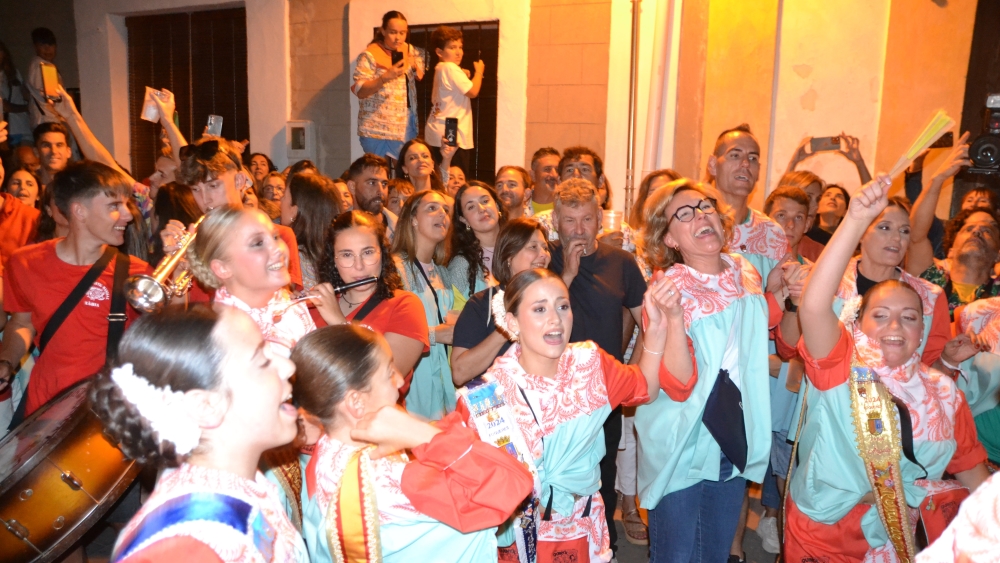
Later that evening, at about midnight, there is the tradition of singing to the images of Sant Joan. The town will have enjoyed a communal dinner together in the Plaza de la Constitución and their singing voices will have been well-oiled with wine or maybe even something a little stronger. A charanga band, the typical brass band that plays popular festive music, will strike up a few songs and several hundred people will gather excitedly behind it as it processes through the maze of dark streets.
The first stop is the niche of Sant Joan in the narrow street of Calle Teulería where the colourful crowd squeezes into any position they can to catch a glimpse of the image which has been decorated with flowers. People climb onto the window grills but the neighbours don’t mind for its all in good nature and, after all, fiesta is here. Many of them gather on the balconies themselves to join in. The band strikes up the “Fogueres” tune and everyone – at least those who know the words; did you remember the songsheet? – sings at the tops of their voices, swaying to the music and then jumping up and down in unison to the stirring chorus.
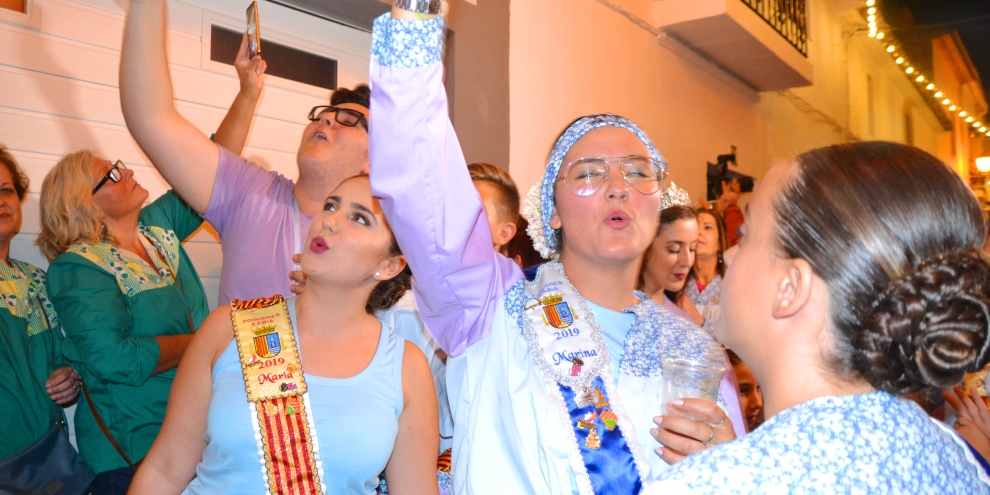
After a couple of verses, the band heads off, leading the crowd to the next destination, the niche of Jesús Nazareno in the street of the same name where “Fogueres” rings out again in honour of the town’s perpetual mayor. And then it’s off again, weaving its way into the historic centre to arrive in the narrow Carrer dels Cups and some more singing to the image of Sant Joan before the cavalcade finishes in the Plaça de l’Esglèsia where the party moves to a conclusion. Quite often there is a bit of sponge cake and some mistela dished out by the organisers but most people are armed with the quintessential plastic bottle of pop – and somehow you just know that they contain something more than coca-cola or fizzy orange.
Almost by tradition, the current ‘quintà‘ often takes over the church steps and no-one else is “allowed” to acquire such a lofty height. From here, they exchange songs, chants and the occasional insult with the peñas and the other quintàs gathered in the square below them. It’s long past midnight, the drink has flowed and to the outsider it might feel like things could get a little out of control. However a firm word from a commission member or a local police officer lurking in the background tends to remind everyone of their social responsibility to their town.
Gradually the square begins to empty as groups of friends disappear in different directions, the younger element either making their way back to their ‘casals’ or heading back to the Plaza de la Constitución where an open-air disco will entertain the more determined of party-goers until almost daybreak. Older and wiser heads will head home, opting for their beds for this is just the start of long celebrations.
FOGUERES
Como una flor que ebria de besos esclata,
Javea por San Juan, en fiestas se desata,
Y el cielo se cubre de rasos y tules,
de verdes los campos, los mares de azules.
Y Junio se llena de blancas quimeras,
De aromas, cantares, guirnaldas y hogueres.
Bulle en gentio en la plaza,
Que en el delirio se abrasa,
De la noche verbenera,
Mientras borda una palmera,
Sobre el cielo la carcasa.
Bajo los arcos triunfales
Formados de murta y rosas,
Orlando ricas carrozas
Van desfilando a raudales
Sus mujeres mas hermosas.
Y hecha luz, verso y quimera,
Se desborda vocinglera,
Y entre jubilo destaca
En cada plaza una hoguera
Y en cada calle una traca.
¡Fogueres!
Festejos que saben a miel
Que vierten perfumes de tu moscatel.
¡Fogueres!
Piropos de gracia y color,
Guirnaldas, floridas, clavel retention.
¡Fogueres!
Destellos de rancio fulgor
Mujeres, suspiros de fiesta hechos flor.
¡Fogueres!
Poesia de un pueblo inmortal
Que reza, que canta, devoto a San Juan
XÀBIA
Com un jardí que esclata en roses,
dins del meu cor vullguera desfullar
El teu fulgor que es el riere d’un poble
Que expressa aixi l’il-lusió l’emoció,
que ens ompli al cantar.
Tot esplendor i alegria, es la fadrina xabiera
La que tothom dona vida,
si algun dia tu en faltares
No se de mi que seria
Des de lo mes fons del cor, trasformant el crit en veu
Desbordant-me d’emoció.
Quan sent cantar esta cançó.
Com un jardí que esclata en roses,
dins del meu cor vullguera desfullar
El teu fulgor que es el riere d’un poble
Que expressa aixi l’il-lusió l’emoció,
que ens ompli al cantar
Xábia tu eres un encant,
la millor terra del món
La que en fa bullir la sang,
l’emoció que em fa que plore
Quan m’allunye del teu mar,
quan divise el gran Montgó
El mes etern vigilant, de la terra que soc jo.
Xábia eres un tresor, joia del Mediterrani
L’alegria del meu sol,
Xábia que bonica eres
Ja mai et podre oblidar,
i des del fons del meu cor
Jo vulguera així expresar,
Xábia que eres un encant.