Every January, as Spain shakes off the chill of winter, towns and villages across the country burst into life for one of the most beloved and symbolic fiestas of the year, the feast of San Antonio Abad, patron saint of animals. Celebrated on January 17th, it’s a day that beautifully blends ancient pagan rites, Christian devotion, and rural tradition, where bonfires roar, bells ring, and animals – from pampered pets to sturdy farm beasts – receive a heartfelt blessing.
Who Was San Antonio Abad?
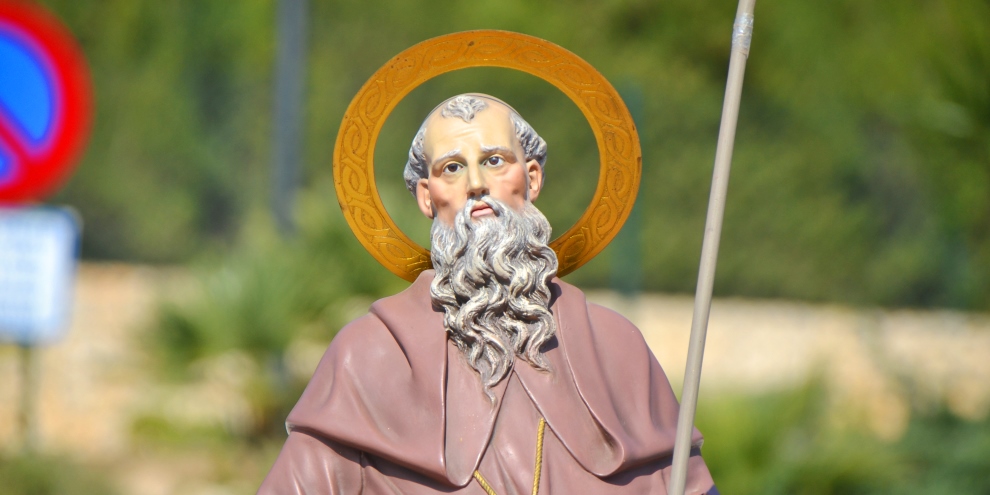
San Antonio Abad (known in English as Saint Anthony the Abbot or Anthony the Great) was a 3rd-century Egyptian hermit regarded as the father of monasticism. He’s often depicted with a pig at his side, a symbol of the temptation he overcame in the desert and his compassion for animals. In Spain, he’s sometimes affectionately known as San Antón, and his feast day is when communities honour not only the saint but also the animals that sustain and accompany them.
A curious iconography accompanies him: the table of San Antonio, laden with bread and offerings; his faithful pig, representing humility and generosity; and sometimes the gates of hell, symbolising the saint’s triumph over sin and darkness.
Fire and Fur Across Spain
Across Spain, January 17th is alive with a mix of faith, folklore, and flame. In cities and villages alike, people bring their pets and livestock – dogs, cats, horses, donkeys, even parrots – to be sprinkled with holy water. The act isn’t merely symbolic; for many Spaniards, it’s a blessing for protection and health in the year ahead.
A Mediterranean Tale
There was once a world without fire. The flames were kept locked within Hell, and the people of the earth shivered from the cold through long winter nights, their teeth chattering so hard they could barely speak.
But the true heart of San Antonio’s feast lies in its fires, those glowing bonfires that fill the streets with warmth, light, and laughter. The tradition, ancient in origin, recalls not only purification and renewal but also a Mediterranean legend that explains how humankind first came to possess fire.
San Antonio was a humble pig-herder, and when he was found in the desert he had a pig that never left his side. Hearing of the frozen lands, he resolved to bring warmth to the people. He went to the very door of Hell and tapped upon it with his birch staff. The demons peered out, recognised the saint, and refused him entry, saying only sinners could cross their threshold.
At that moment, the pig, always by his side, grunted loudly and scratched the door. The demons, thinking of “roast pork,” agreed to let the animal in, but not the saint. The door opened just a crack and the pig charged through, causing such havoc that the demons, desperate to calm the chaos, allowed San Antonio to enter too.
Inside, the saint calmed his companion with a gentle touch of his staff and warmed himself by the fire. But when the demons tried to mock him, a mischievous one tripped over his staff and thrust it into the flames. Seizing his chance, San Antonio’s pig again caused commotion, and the saint demanded his staff back to quiet the creature. When it was returned, he tapped the pig once and peace returned.
Ordered to leave, San Antonio departed through the gates of Hell, carrying his birch staff, now smouldering within. The demons did not see the hidden ember inside its dry core. Once above ground, the saint raised the staff high and shook it, sending sparks into the night sky. From that time on, there was fire in every hearth, and people gathered round it to tell stories on cold winter nights.
As for San Antonio, he and his pig returned to their simple life in the desert, having given warmth to the world.
This story, born of the Balearic Islands, still flickers in Mediterranean memory. In Mallorca, Ibiza, and Menorca, locals dress as devils and dance around roaring bonfires that symbolise the flames stolen from Hell. In Jaén, up to thirty fires blaze across the city with singing, wine, and pork sausages. Catalonia, ever fond of a fiesta with fire, lights its foguerons through the night in towns like La Granadella, while Canals, in the province of Valencia, claims to build the biggest pyre of all, nearly twenty metres high and twelve wide, honouring the saint who brought light to humankind.
San Antonio in Jávea: Tradition on Two Fronts
Few towns capture the spirit of San Antonio Abad quite like Jávea, where the celebration unfolds in two distinct but equally charming events, one in the old town and one in the port zone.
The Historic Centre
In the historic area, the equestrian group CAE El Tiraset plays a central role over the weekend nearest to the feast day of San Antonio. In a tradition rooted in local custom, the group drags a fallen pine tree through the streets to a small square on the outskirts of town, temporarily renamed Plaza San Antonio for the festivities. That evening, the pine is used to create a modest but symbolic bonfire, illuminating the square as residents gather to watch the flames flicker, a reflection of San Antonio’s legendary gift of fire.
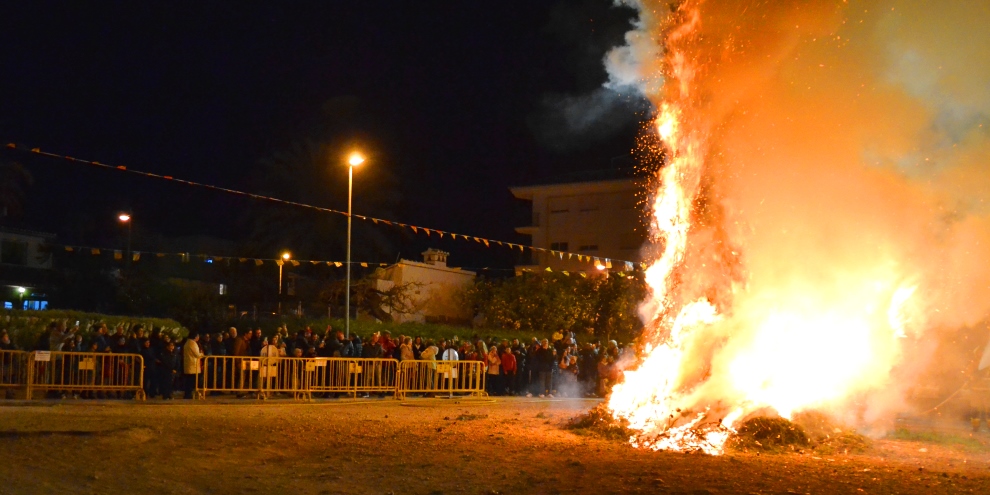
Firemen are on hand to prevent the inferno from sliding out of control, spraying down the dry ground around it. Once the branches have burned away, the trunk stands alone in the darkness, defiant against the flames for as long as possible until it finally succumbs and collapses to the ground to the cheers of the crowd. As the flames die down, the crowd drifts away for dinner.
The following morning , the “festeros” gather in the square. The image of San Antonio Abad is placed in the wooden cart ready for the procession through the streets of the old town and the port. The procession of animals, wooden carts and, most importantly, the image of San Antonio Abad set off on the parade, kids travelling in many of the wooden carts down the hill to the port and then back up to arrive at the large Plaza de la Constitución.
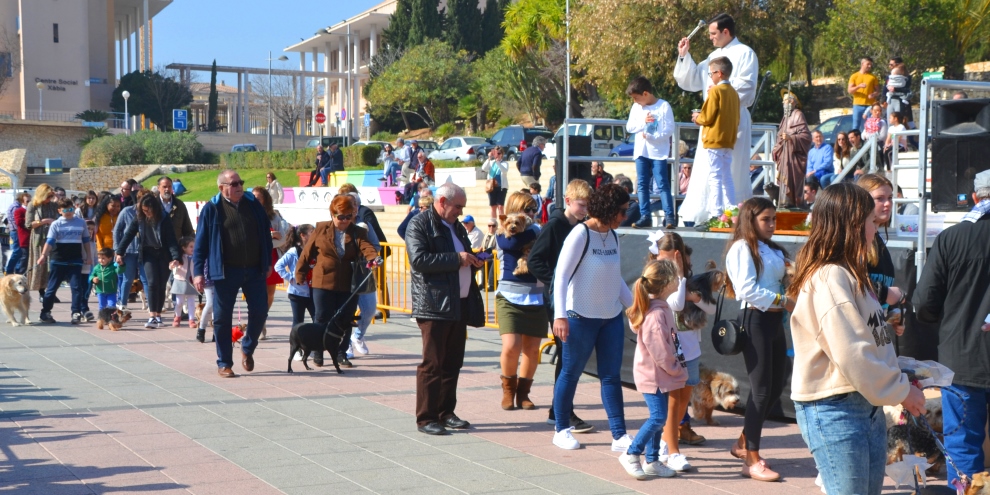
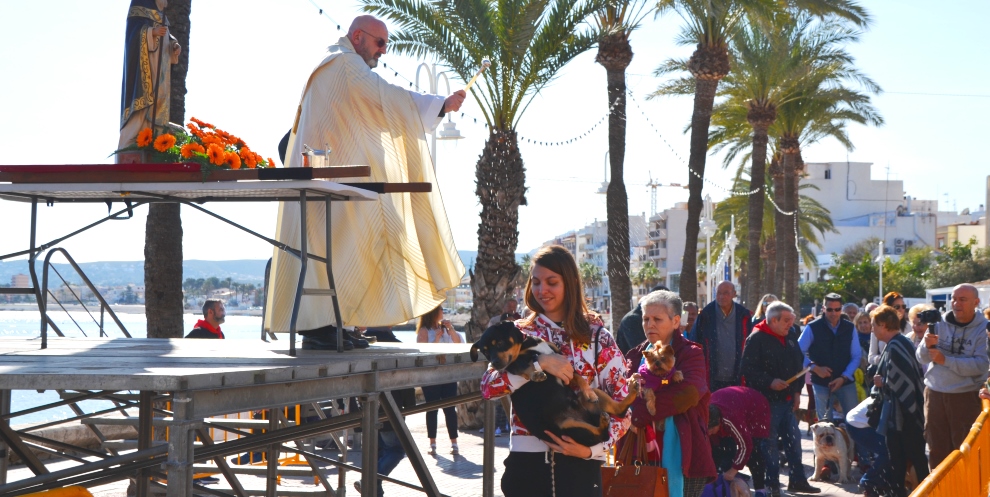
It’s a long process but a joy to watch as each participant walks in front of the stage to be blessed with holy water; they also receive a little snack and a card with the image of San Antonio and the words of the blessing written in Spanish as well as a chance to enter a draw to win an image of San Antonio Abad. As the early afternoon draws on, the blessing concludes and the image of San Antonio, which had been placed on the stage beside the priest, is loaded back onto the decorated cart and makes its final journey back to its niche.
Duanes de la Mar (The Port)
On the feast day itself – January 17th- in Jávea’s port area, the day begins with a modest procession through the streets of the port, accompanied by the sound of traditional dulzainas and drums. Participants then gather at the iconic Loreto Church for a solemn Mass, celebrating the saint and his enduring connection to animals.
After the service, a second procession carries the image of San Antonio Abad through the streets to the port square. Here, families assemble with their pets and livestock for the official animal blessing, as the priest moves from creature to creature, sprinkling holy water and invoking the saint’s protection. Against the striking backdrop of the headland of San Antonio, keep an eye on the cliffs; you may just spot the shape of San Antonio himself, a hidden charm that, once seen, is never forgotten.
The Chapel of San Antonio Abad
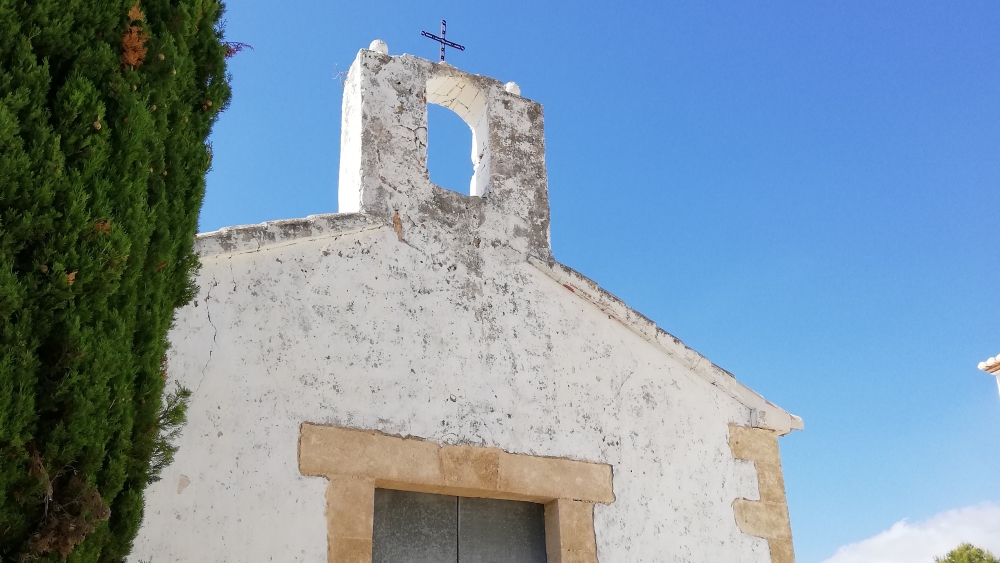
A short distance inland, beyond the town and fields, lies a quiet corner of devotion: the chapel of San Antonio Abad, part of the La Alquería de Benitzaina farming estate. For over a century, this site has been the subject of a friendly territorial debate between Jávea and Dénia.
While the estate lies within Dénia’s borders, most neutral accounts agree that the chapel, though dependent on the estate, stands on Jávea’s land, with its north and west walls marking the boundary between the two towns. Yet in the hearts of the faithful, the chapel has always belonged to Jávea.
Built in the 18th century, the estate is an impressive rural complex once dedicated to farming and livestock, featuring fortified structures for protection in less peaceful times. The chapel, first mentioned in 1791, remains privately owned and remarkably well preserved.
Its whitewashed masonry, stone-framed entrance, and simple iron cross convey rustic grace. Inside, the rectangular nave is roofed with beams said to have been fashioned from the masts of old sailing ships, a poetic reminder of Jávea’s maritime soul. On the altar, a painted retablo imitates marble, and within its niche stands the image of San Antonio Abad, serene guardian of the animals and giver of fire.