
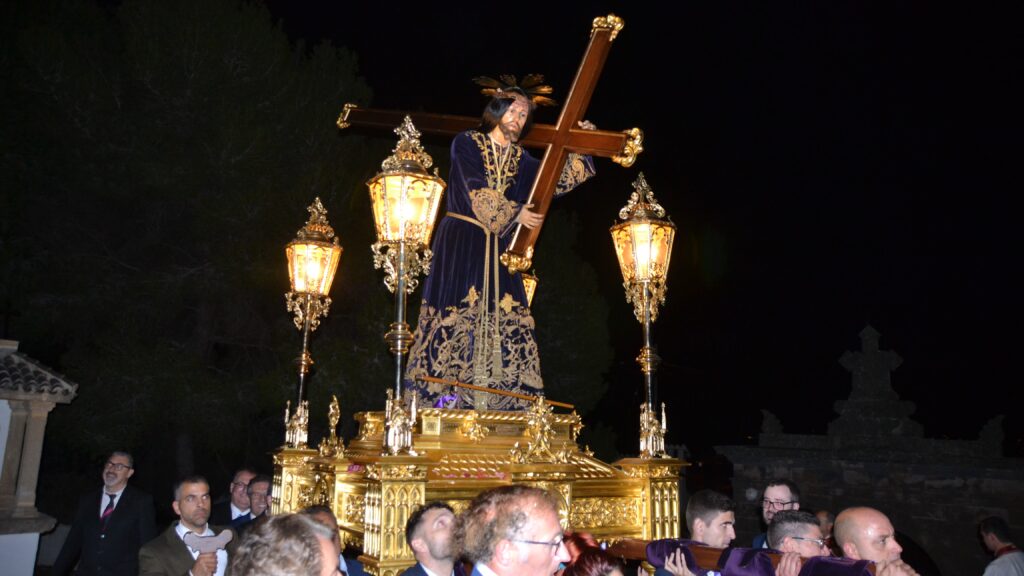
May 3rd is the final day of the festivities that honour the town’s treasured image of Jesús Nazareno. Since the Third Sunday of Lent, when it was carried in solemn procession from the iconic blue-domed chapel of Calvario, the Nazarene has been presiding over the town as “perpetual mayor” during the Semana Santa / Easter celebrations and during the festivities that have been held in its honour for over 250 years. Now, it is time for the image to be returned, carried back up the hill on the strong shoulders of the Brotherhood to be placed back inside the chapel for until next year. This is an act known as La Subida a Jesús Nazareno – the ascent of Jesus Nazareno.
The image of Jesús Nazareno
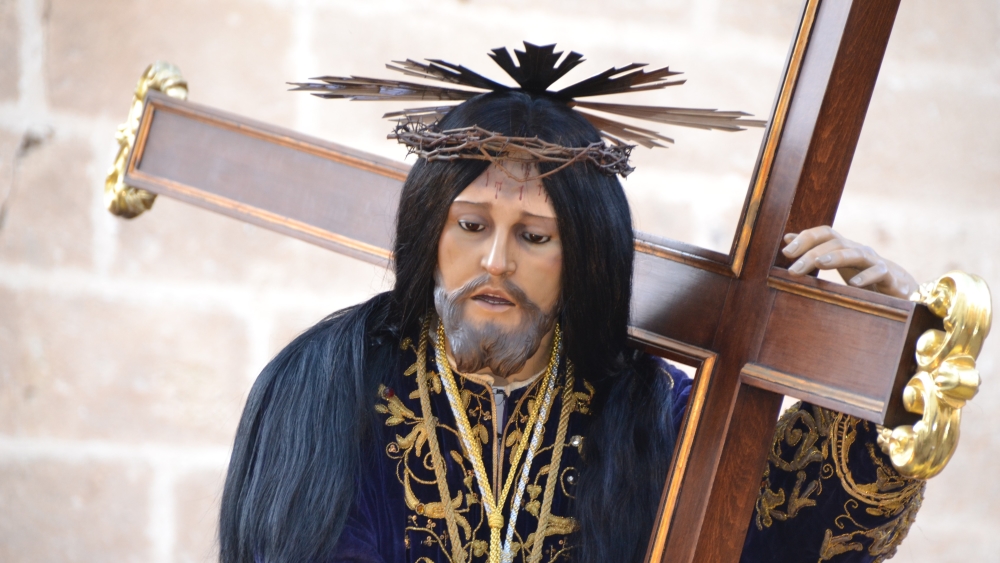
The original image of the Nazarene arrived in Xàbia in October 1767, a gift to the village from the Dukes of Medinaceli, the lords of the manor, in thanks for the congratulations extended to them after the birth of their first-born. Sadly, the one we see today is not the original. After the outbreak of civil war across Spain in July 1936, the image was brought down from the chapel of Calvario, stripped of its robes and dumped in what is now Calle Buen Aire where it was pounded by intense summer rains; any attempts to rescue it were confounded by suspicious eyes and fear of repercussions. In September, the image was moved down to the Placeta del Convent and set ablaze by militiamen, watched by emotional neighbours whose devotion to this, their treasured image, was so great.
After the war, the first official mass in the village took place in the ruins of the Convent church where an oil painting of the Nazarene was hung at the doors that remained, an improvised altar was built and adorned with chalices and smaller images that had been hidden away during the tragic conflict. They could destroy the physical image but they couldn’t destroy the devotion to it and efforts were made to create a replacement.
As luck would have it, the face of the Nazarene of Calpe, which had survived the war, had been sculpted from a mask created from the original image of Xàbia and the tunic it had worn had been removed and hidden away. A replacement image was commissioned from the Valencian sculptor José María Ponsoda Bravo, the one that we see today, and it made its first appearance in procession in 1941. One thing to note: Xàbia’s Nazarene is the only one in Spain where the cross slopes downwards, being smaller in size and becoming more a symbol than representation.
In October 1967, to mark the 200th anniversary of the original image’s arrived in Xàbia, the local council appointed it the title of “Mayor Perpetual of the Villa de Xàbia” and to this day there is the traditional baton of office placed permanently at its feet and no mayor of the municipality may carry such a baton during religious events which involved the image of Jesús Nazareno. During the celebrations, the image was carried down the port zone to mark its arrival by sea back in 1767 before being carried back up to the historic centre and then to the chapel of Calvario.
In October 2017, the town marked the 250th anniversary – and the 50th anniversary of the image being affored the title of “Mayor Perpetual” – with a special programme of events which included a special institutional act in front of the town hall during which it was presented with a commemorative medal and baton, and an emotional act in which it was carried down to the port zone for a reunion with the image of Mare de Déu de Loreto, a special mass, and a overnight stay in the square in front of the port church.
Click here for more information about the fiestas that honour the image of Jesús Nazareno.
May 3rd – La Subida del Nazareno
This special day begins early at 7.30am with the ringing of the church bells of San Bartolomé to mark the occasion. With the return of the bells in 2024, their sound is especially pleasing to hear these days. A little later, there is a tronà – a thunderous explosion which breaks the early morning silence. In their homes, many xabieros are digging out their finest clothes for this emotional occasion and at midday they head to the church of San Bartolomé in the heart of the historic centre for the Eucharist. The church is full, such is the moment, often with standing room only on the sides and the mass is enhanced by the parish choir.
At the end of the mass, the congregation makes it way down to the Plaza de la Constitución for the deafening mascletà. There’s not specific time in the programme; it will be when it will be, after the mass has finished and everyone has made their way down to the big square.
As the sun begins to sink towards the horizon, the people return to the church of San Bartolomé for the evening mass after which the church square in front of the door of San Gil will begin to fill up very quickly with those having just attended mass with those who didn’t do so but will be joining the images on their way back up the hill to the chapel of Calvario. Anyone can join in but those wishing to do so should be mindful of not sliding into the middle of a family group, fiesta commissions, Brotherhoods, or the local council representatives.
As the light begins to dim, many candles are lit, carried by devotees to light the way for their treasured image. The solemn procession begins suddenly, led by the traditional pairing of single drum – the tabalet – and the dulzaina – la dolçaina – which often lead processions in the Valencian region. Also involved are the band of dulzainers and drummers who often accompany the image of La Dolorosa whilst playing Enric Gironés’ slow Processó Nº1 whilst at the rear of the procession is the town band playing a popular processional march – often Jersulén by José Vélez García.
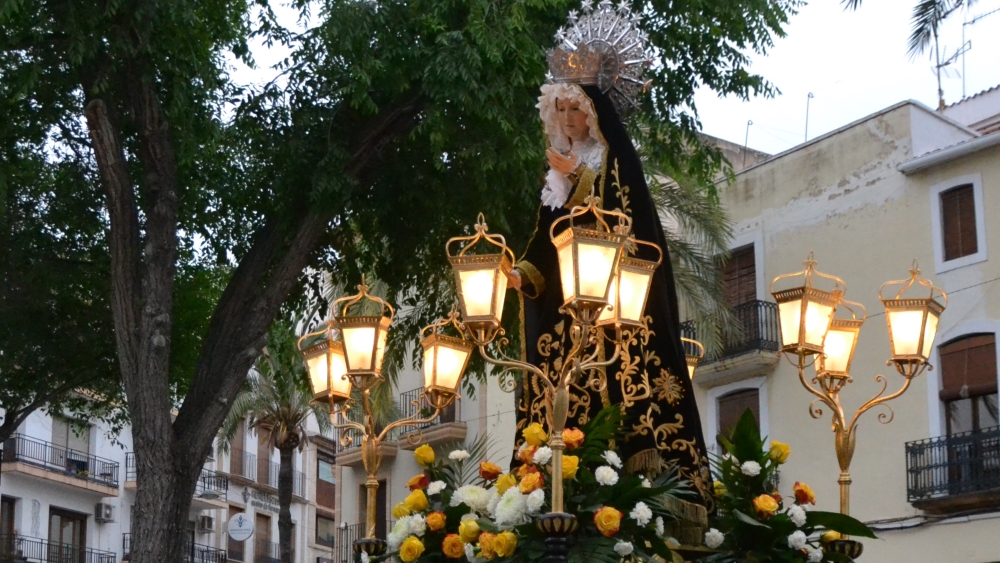
The first image being carried is that of La Dolorosa which used to be one of the most venerated images in Xàbia. The first record of the image being registered in our town dates back to the second half of the 18th century and that the Bover family was its guardian for at least 200 years before it passed to Casa Bolufer through the marriage of Rafael Bover Albi to Joaquina Bertomeu Bolufer in the 1920s. The following decade, during the tragedy of the Spanish Civil War, the image was destroyed by Republican forces but not before the sculptor Juan Bautista Devesa Sapena “El Santeret” risked his life to make a mold of the face and the Bover family saved the crown, hiding it away in an animal pen. After the war, a new image, this image being carried today, was created and first revealed in the mid-1950s.
The procession is long, winding its way through the narrow streets of the historic centre and one of the best places to observe it is the Placeta del Convent where the bells of the convent church ring in acknowledgment. Looking up Carrer El Forn, the candles make the old town houses living the narrow street glow in a warm golden yellow, the light picking out the tosca stone with which many of them have been built. It takes about 15-20 minutes to pass through the square, perhaps a little longer, but there’s no rush for this is such a special moment for the people of Xàbia.
Many groups and associations are represented in the procession, including the fiesta commissions of the festivities of the Fogueres de Sant Joan de Xàbia, those of Mare de Déu de Loreto de Xàbia, and the Moros i Cristians de Xàbia. Their highest representatives accompany the images; the traditional dresses worn by the young women always draw mutterings of approval whilst the handsome young men in their closely-fitted suits sometimes shuffle uncomfortably and pull occasionally at their collars for the evenings are starting to become quite warm.
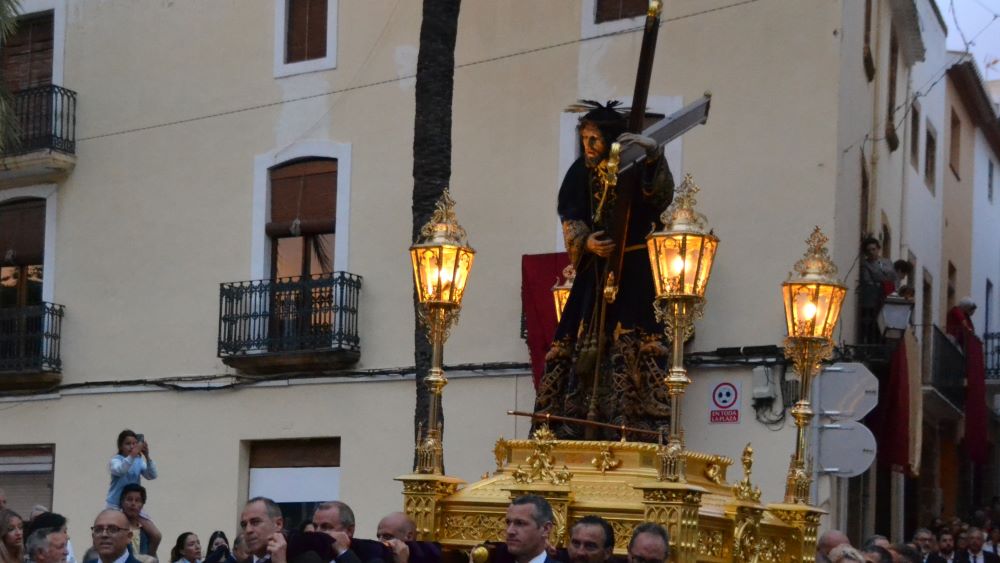
The passing of the town’s treasured image of Jesús Nazareno is greeted with a respectful silence from those lining the route. Carried by its Brotherhood, it creaks and sways along the route, stopping now and then to allow its bearers a brief respite or to be replaced by other members of the Brotherhood walking alongside.
And they often need all their strength when the procession passes along Carrer Jesús Nazareno where the carefully-maintained niche containing an image of the Nazarene is located, placed perfectly into the wall of a marvellous house in the street. Both images – La Dolorosa and El Nazareno – stop momentarily in front of the niche and their bearers slowly and carefully bring them about so that they face it. A moment of silence and then those at the front of each image gently and slowly bend their knees whilst those at the back lift their arms so that the images appear to bow very gracefully at the image in the niche. It’s an emotional moment for everyone involved and often small rose petals are dropped from balconies above.
The procession makes it way back into the historic centre, slowly climbing up Carrer Mayor and through Plaça del Baix before climbing the steps at the far end to enter the church square once again. The church balls ring loudly as the images pass by, making their way along the wall of the old defensive tower and past the municipal market.
There’s still a long way to go and night is falling. The procession crosses Ronda Norte and makes its way up Carrer Calvario then, passing by the roundabout at top, begins the final ascent to the chapel of Calvario. Those walking take the steep Carrer Cañones slowly, taking advantage of each momentary stop to catch their breath, before passing through the grand gateway to enter the Vía Crucis.
Those carrying the images have a greater task and they pause for a few seconds at the bottom of the steep road to prepare for the ascent, allowing the devotees to clear the way for they will march at pace up the road. When the signal is given, the bearers lift the images onto their shoulders and then walk swiftly in one go to the top of the road and then take a breather at the gate for the trickiest part of the procession is about to be overcome.
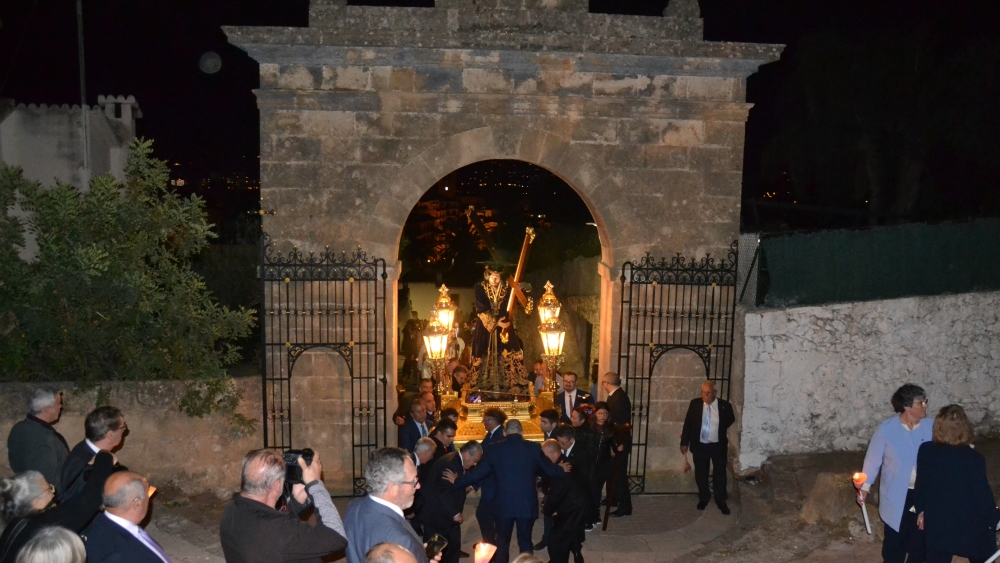
The image of La Dolorosa comes through fairly easily on the shoulders of its bearers but the bigger image of El Nazareno needs a more coordinated effort. It’s a big statue and a narrow gate. It’s no wonder the procession ahead often comes to a halt and devotees dig out their mobile phones and cameras to record this most engaging of moments in the whole procession.
It needs plenty of coordination and it may seem that the cacophony of voices are confusing at first as the great image is lowered off the shoulder and into crook of the arm. But there’s an understanding. On command, the bearers, most of whom are now bent over in a deep bow position, shuffle their feet carefully to carry the image through the gate. More arms come in to help as the weight of the image shifts as it sways from left to right. There’s a step – there’s always a step – and feet are lifted carefully over it. Occasionally, there’s a gasp as it sways perhaps just a little too much to one side but the Brotherhood are experienced enough to adjust, get the image through the gate and then, in one swift confident movement, lift it back onto their shoulders. Job done.
The passing of the image back through this grand gate and onto the final winding path that leads up to the chapel of Calvario is marked by a succession of rockets fired from a nearby location. Some waiting down in the main square for the fireworks which follows the procession can often mistake these explosions in the darkening sky for the start of the display. But they are not. There is probably still another 45 minutes to an hour to go before the image is safely returned to sit below the blue dome and the devotees and Brotherhood make it back down into town for the display.
Once the images are safely through the gate, they are carried slowly up the winding Vía Crucis, the candles being carried by the devoted lighting up the gloom between the tall trees, and arrived at the square in front of the chapel where they are prepared to be carried into the building. Once again, La Dolorosa enters with little drama but it’s another matter with El Nazareno which has to be dropped into crooks of arms once more and shuffled slowly into the chapel. Those bearers deserve all the applause that is afforded to them as they get through the door, heave the image onto their shoulders, and make the last final few steps to its resting place. ¡Bravo, chicos! ¡Bravo!
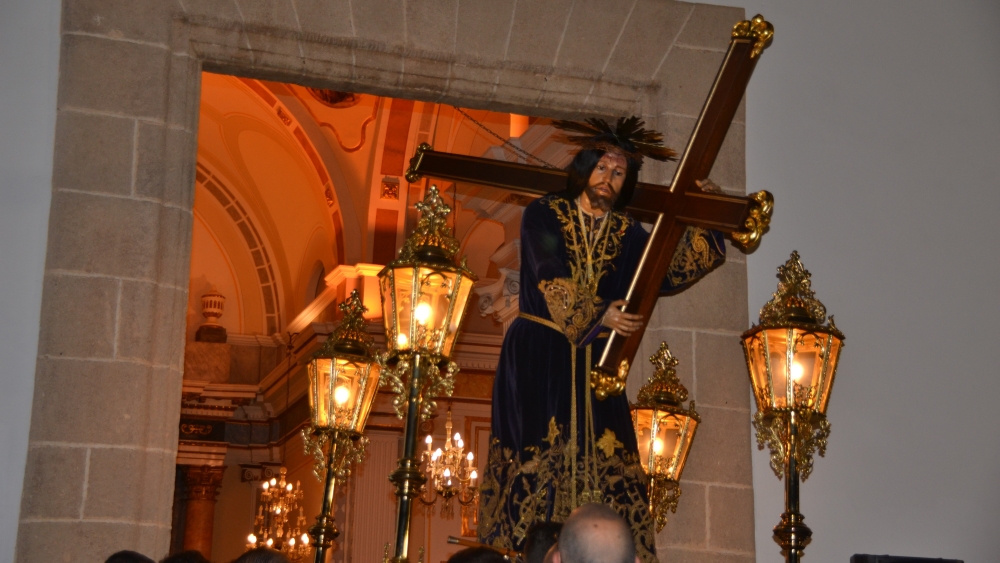
A few words from the parish priest end this special ascent of the image but already many of the devoted are making their way back down in the increasing darkness, their way lit this time by mobile phone torches, until they pass through the grand gate and quicken their pace down the steep hill to the Plaza de la Constitución where a sizeable crowd is already waiting, most patiently so.
There is no set time for the launch of the firework display which brings everything to an explosive end. It happens when it happens, but specifically when the Brotherhood, devotees and council representatives have made their down through the darkness to the square.
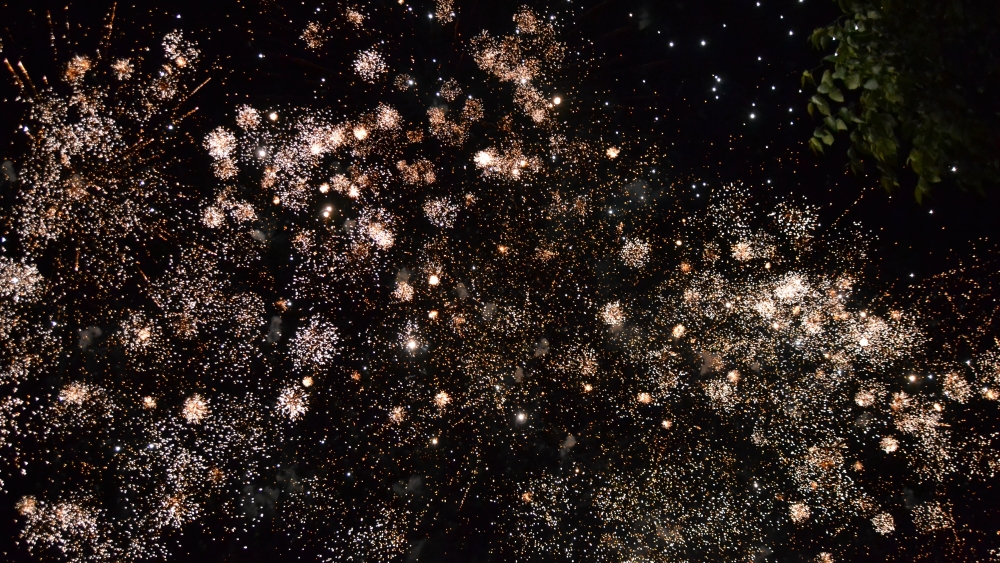
Get a feeling for this special occasion …
Note that if May 3rd falls on a weekday, then it is a local bank holiday and schools will be closed as well as most shops and businesses.
RESEARCH SOURCES
José FONT CABALLERO. Jesús Nazareno. 250 años de devoción en Jávea.
Juan LEGAZ PALOMARES. Memorable historia del Nazareno de Xàbia