
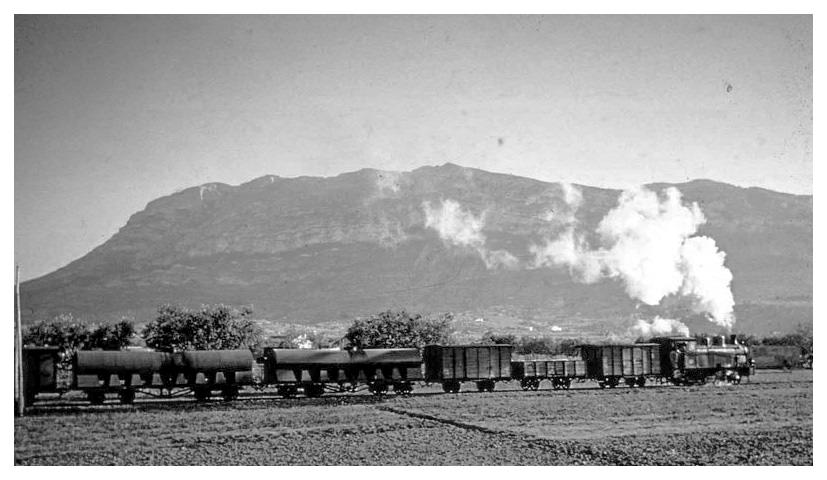
Despite lying a mere seven kilometres apart as the crow flies, Xàbia and Dénia have long felt worlds away. Anyone without private transport knows the reality of that distance, not only between these two neighbouring towns, but between Xàbia and almost anywhere else. This enduring sense of isolation has shaped daily life for generations, and it became painfully clear in the summer of 1915, when the long-awaited railway linking Alicante to Dénia was finally completed. The line swept past Xàbia without stopping.
The decision was difficult to justify. Xàbia occupied a strategic position along the eastern coast, with a busy port that had exported the region’s agricultural produce for decades. Its wide, sheltered bay had long served as a natural refuge for vessels navigating the Mediterranean. Yet despite these advantages, the town was left off the rail map, cut adrift just as modern transport was reshaping the economy of the region.
By 1910, railway tracks were already advancing northwards from Alicante and had reached Villajoyosa, with preparations well underway to extend the route to Dénia. An engineer’s report published that same year was blunt in its assessment: the planned line completely ignored Benitatxell and Xàbia, abandoning not only the towns themselves but the economic interests of the wider region.
The report went further. Xàbia, it argued, was of particular strategic importance. Military experts regarded its bay as one of the most favourable landing points along Spain’s eastern seaboard, a vulnerability that demanded protection. This concern was still fresh in national memory following Spain’s short and disastrous war with the United States in 1898. In addition, Xàbia was a vital communications hub, linked to the Balearic Islands by two underwater telegraph cables that connected the archipelago to the mainland.
To bypass such a town, the report concluded, was a grave mistake. By the early twentieth century, Xàbia had become one of the busiest ports in the region. Its fishing fleet was landing such vast quantities of fish, the authors claimed, that they could “fill all the squares of the province” if only a railway existed to carry the catch inland. Thousands of tons of “extraordinarily economical” tosca stone were being quarried along the coast, prized for construction and irrigation works across the Marina Alta, yet transport remained slow and costly. All of it, the report insisted, could move efficiently… if it had a railway.
The frustration was sharpened by the fact that solutions had long been proposed. As early as the late nineteenth century, plans had been drawn up to connect Xàbia to Dénia by steam-powered tram via Gata de Gorgos and Ondara. These ideas emerged at a moment of profound economic anxiety. The raisin trade, once the engine of local prosperity, had collapsed under the combined pressures of disease and foreign competition. Xàbia had been a pioneer of the industry in the mid-nineteenth century, and the grand mansions and palatial homes that still line its streets stand as silent witnesses to that lost golden age.
By the turn of the century, fortunes had faded. Wealthy landowners struggled to reinvent themselves, while unskilled labour became increasingly scarce as workers left in search of employment elsewhere. The town faced not just economic decline, but the risk of social fracture.
In 1904, with the Marina Alta edging towards economic and social collapse, a detailed report was commissioned to revive the region’s fortunes. It resurrected a plan for a railway loop linking Xàbia to Dénia, a project previously abandoned amid underinvestment and administrative obstruction. Momentum appeared to be building. In 1912, the government ordered a further technical study into a direct link between Gata de Gorgos and Xàbia. Engineers confirmed that a line could be laid across the valley to terminate at the port.
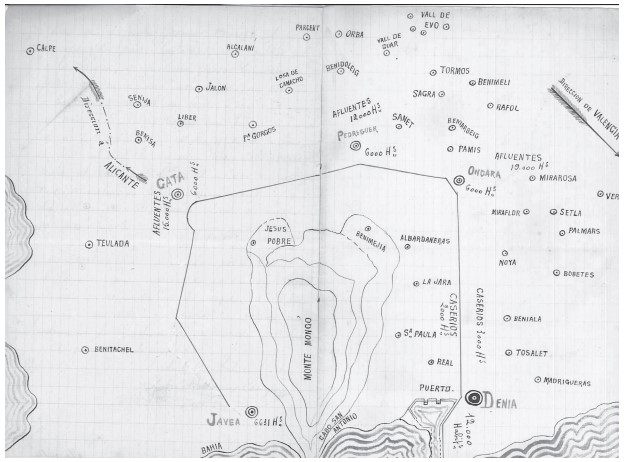
In April 1914, the breakthrough finally came. A project was approved for a railway branch measuring 10,816 metres, including an intermediate station in the town and a terminus in the port area. The budget stood at just over two million pesetas, the equivalent of around 8.3 million euros today. At last, Xàbia seemed poised to join the rail network.
Two days after the project went out to tender, the Archduke Franz Ferdinand of Austria was assassinated in Sarajevo.
The gunshots fired by a young Serbian nationalist, Gavrilo Princip, unleashed a diplomatic crisis that rapidly spiralled into the First World War. Europe slid towards catastrophe, and the ambitions of a small Mediterranean town were swept aside by events far beyond its control.
Spain, still reeling from the humiliation of 1898, was grappling with its own economic and political instability. Its army was aging and underfunded, its international position weakened, and its attention divided between unrest in North Africa and the enduring question of Gibraltar. When war broke out, Spain chose neutrality. The consequence was a sharp reduction in investment in heavy industry.
Work on the main railway line between Villajoyosa and Dénia was delayed, eventually opening in July 1915. The branch line to Xàbia, however, was quietly abandoned. The plans were filed away, and soon forgotten.
A century later, the sense of isolation remains. For those without private transport, even a journey to the region’s only hospital can be difficult and expensive. There is a bus service, of sorts, running between Xàbia and Dénia, but only on weekdays and with limited frequency. Regional and national routes do not permit short journeys, unless one encounters a rare sympathetic driver.
It is tempting to think this is a modern problem. It is not. Once, there was a serious and determined effort to link Xàbia to the rail network, grounded in economic logic, strategic necessity, and regional ambition. And then history intervened. A single shot echoed across Europe, and the railway that might have changed the town’s future never arrived.