
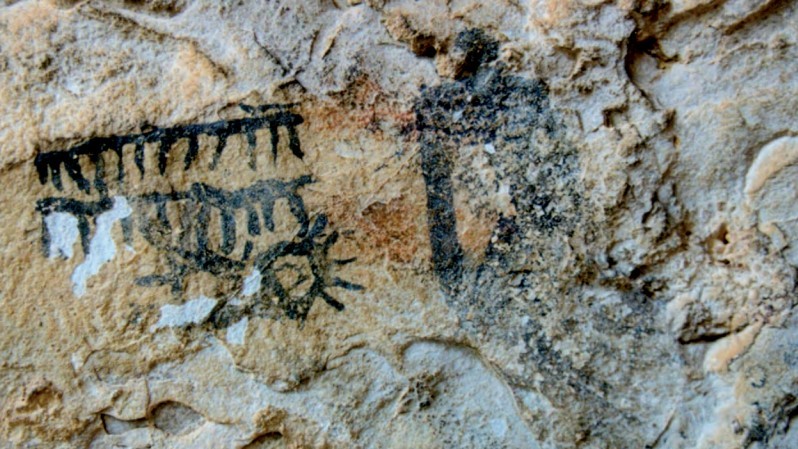
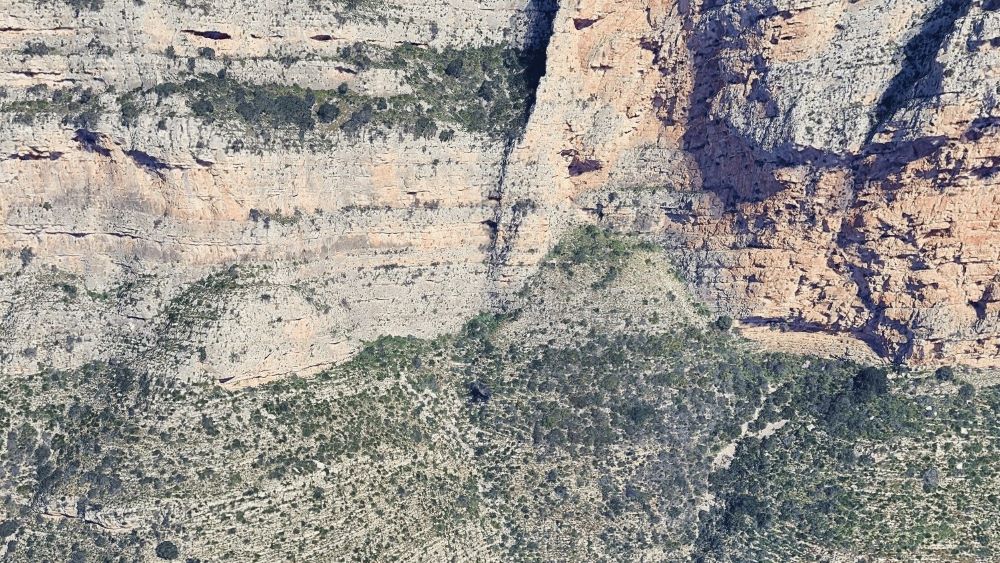
High on the sunlit cliffs of Montgó, forty metres above the valley floor, a shadow opened in the rock, a doorway to another time. It was April 1989 when a group of young climbers from the Centre Espeleològic de Gata, ropes slung across their shoulders, descended the limestone walls of the Barranc del Migdia. Partway down, they stopped before a dark cavity halfway up the sheer face. Curiosity drew them inside. In the beam of their headlamps, black-painted motifs flickered to life across the walls and ceiling, as if ancient hands had only just lifted the brush. Scattered across the floor lay pottery fragments, most belonging to a broken but almost complete earthenware jar glazed in shimmering turquoise. On later visits, as they explored the cave more carefully, the cavers gathered a small but remarkable collection: a handmade hemispherical vessel with a straight-edged rim curving inward, a flint arrowhead with a concave base, a flake of the same stone, and a few fragile bones.
This was no ordinary cave. The Cova del Barranc del Migdia had served as a sacred resting place for a prehistoric community. Its central chamber, just a few metres across, held the remains of men, women, and children, carefully grouped in burial “packages” and accompanied by offerings: flint arrowheads, polished stone axes, tiny idols, and ceramic vessels that may once have held milk or food for the journey to the afterlife. The space feels intimate yet monumental, a silent chamber that has witnessed thousands of years of human presence.
The real marvel, however, is the art. Painted mostly in black, with a few red touches, the cave’s images are both geometric and lifelike: zigzags and triangles, comb-like forms and stars, miniature goats caught mid-run, and stylized human figures. Some images depict enigmatic “eye idols,” small but striking figures that seem to watch over the chamber. The paintings are tiny in scale yet precise, revealing a sophisticated visual language created around 2,700–2,250 BCE.
The cave’s secrets were carefully revealed over decades of archaeological investigation. In 1990, the Soler Blasco Archaeological and Ethnographic Museum in Xàbia began documenting the paintings with detailed tracings and analysis, culminating in a comprehensive study published in 1997. Yet it was not until 2009, thanks to funding from the Fundació Cultural CIRNE, that systematic excavations began. Over five campaigns spanning 2009 to 2014, archaeologists uncovered the burials, mapped the chambers, and catalogued the funerary offerings, providing a rare glimpse into life and death in the Montgó valley during the Copper Age, the transitional period just before the widespread use of bronze.
Interestingly, the cave also preserves traces of later human activity. A few fragments of pottery discovered correspond to types of Roman pottery that can be dated to the 3rd and 4th centuries AD, well within the period of the late Roman Empire. Their chronology matches materials found at other Roman sites on Montgó’s sunny slopes. These minor settlements, situated on steep, agriculturally poor terrain, were likely linked to livestock farming, almost certainly goat herding, a practice documented in the area until the last century. During these times, the cave was probably used as a refuge by shepherds, offering shelter in an otherwise challenging landscape.
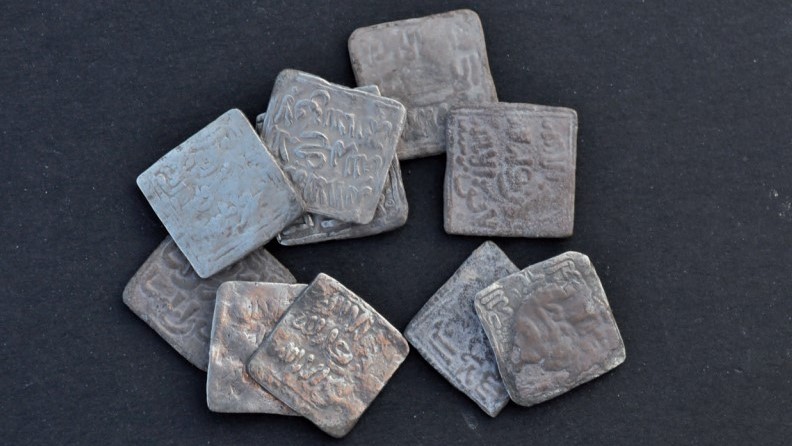
In the 1990s, archaeologists discovered a hoard of Almohad-period Moorish coins in the dark entrance to the Chamber of Paintings. These ten square silver dirhams, two of which bear mint marks from Murcia and Fez, may have been hidden just before the arrival of new conquerors, a story echoed in other sites across the region. In addition to these coins, a ceramic jar glazed in turquoise green and two fragments of a ceramic jug decorated with “scraffito” were also found in the Chamber of Paintings. These pieces date to the same period as the coins, roughly between the mid-twelfth and early thirteenth centuries. Perhaps those shepherds, familiar with Montgó’s secret recesses, tucked the hoard and ceramics away for safekeeping. Today, most of these objects are housed in the municipal museum.
In 2013, the results of these years of research were brought vividly to life in the exhibition Art i Mort al Montgó (“Art and Death on Montgó”), organized by the Museo Arqueológico de Alicante (MARQ) with support from both regional and national governments. The exhibition has since become a permanent installation at the Soler Blasco Municipal Museum in Xàbia, allowing visitors to step into the world of Montgó’s prehistoric inhabitants and the remarkable cave where art and ritual once met.
The Cova del Barranc del Migdia is more than an archaeological site, it is a time capsule perched on a cliff, where art, death, and human ingenuity converge. From the tiny painted goats on the ceiling to the carefully arranged bones below, the cave tells a story of people deeply rooted in the land, bound to their valley, and leaving traces that still speak to us today.
Sources:
- LA COVA DEL BARRANC DE MIGDIA · https://amuxabia.weebly.com/la-cova-del-barranc-del-migdia.html
- ART i MORT AL MONTGO · La Cova del Barranc del Migida de Xàbia. Rituales Funerarios en Un Santuario del III Milenio A.C. (MARQ 2013)