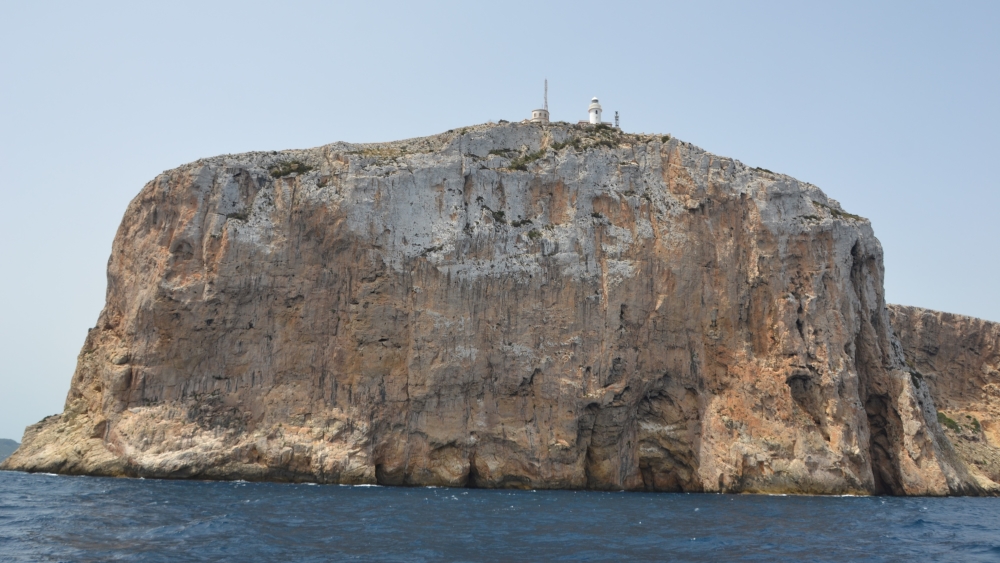
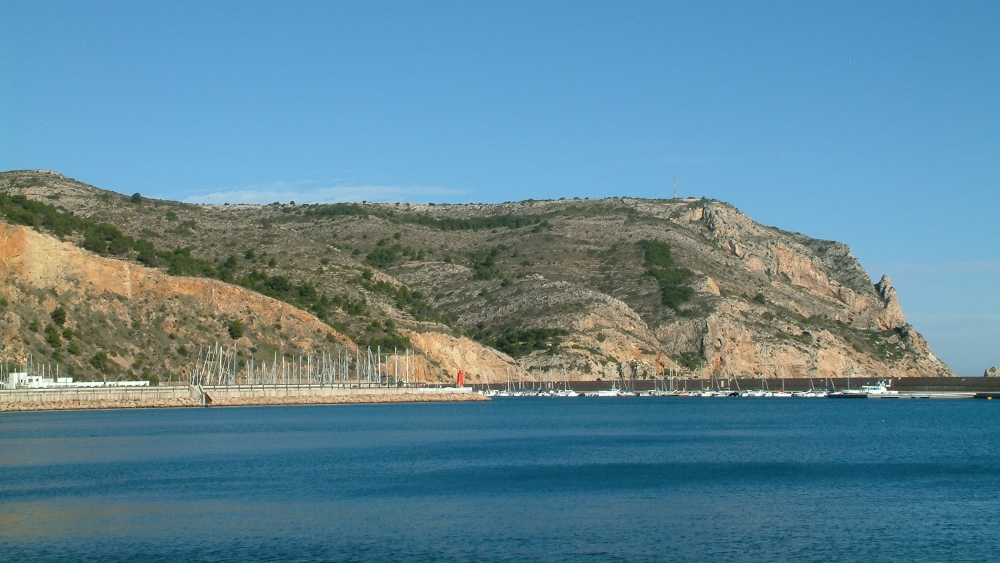
Sitting at the eastern end of the Parque Natural del Macizo del Montgó and jutting out into the Mediterranean, Cabo de San Antonio – also known in Valencian as Cap de Sant Antoni – offers some of the most breathtaking coastal views along the coast of Valencia. Beyond the scenery, this spot is also steeped in fascinating history.
The headland is easy to reach, drivers can follow the CV-7362 from the Xàbia-Dénia road, while those with a little more energy can hike up from the port area along the PR-CV 355 path, a climb of just over a couple of kilometres that rewards every step with sweeping views over the bay.
Sor Basota and the Hermitage
The cape’s story begins in the 14th century with Catalina Bas, better known as Sor Basota. Seeking solitude and spiritual reflection, she settled in a cave called Basota in La Plana, between the Montgó and the cape. In 1377, she received permission from Alfonso de Aragón, Count of Dénia, and his brother Jaime de Aragón, Bishop of Valencia, to build a hermitage nearby.
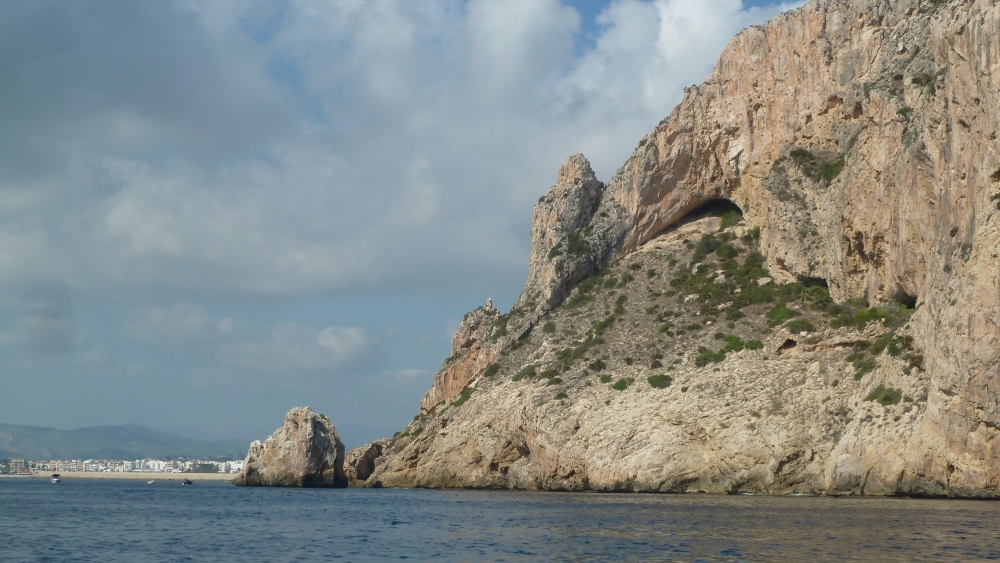
It wasn’t unusual for religious figures to retreat to remote locations as an act of devotion, and Sor Basota was no exception. The hermitage she built was dedicated to San Antonio (Saint Anthony), and the cape itself eventually became known as Cabo de San Antonio, reflecting this dedication rather than the hermit herself. Interestingly, from certain angles, especially from the sea, a striking rock formation rises from the cliffs, standing tall like a sentinel. Locals say it resembles a human figure, perhaps even San Antoni himself, and some believe this natural “statue” helped cement the cape’s name.
Coves Santes – The Holy Caves
Beneath the cliffs lie the Coves Santes, or Holy Caves, a remarkable complex of natural caverns with deep historical and spiritual significance. The main cave, known as Coves Santes de Dalt (the “Upper Holy Caves”), sits about 140 metres above sea level. It is roughly 25 metres wide at its mouth and 10 metres at its highest point. A steep slope drops down towards the sea and leads to the four lower cavities, known as Coves Santes de Baix (the “Lower Holy Caves”), which sit between 90 and 110 metres above sea level.
These caves were first settled by Hieronymite hermetic monks around 1340, a movement that sought out caves, mountains, and other remote places to find solitude and tranquillity, enabling a closer connection to God. Twelve hermits withdrew to these caves, including Catalina Bas choosing a higher cave on the cliff face, now known as the cave of Sor Basota, which remains exceedingly difficult to access.
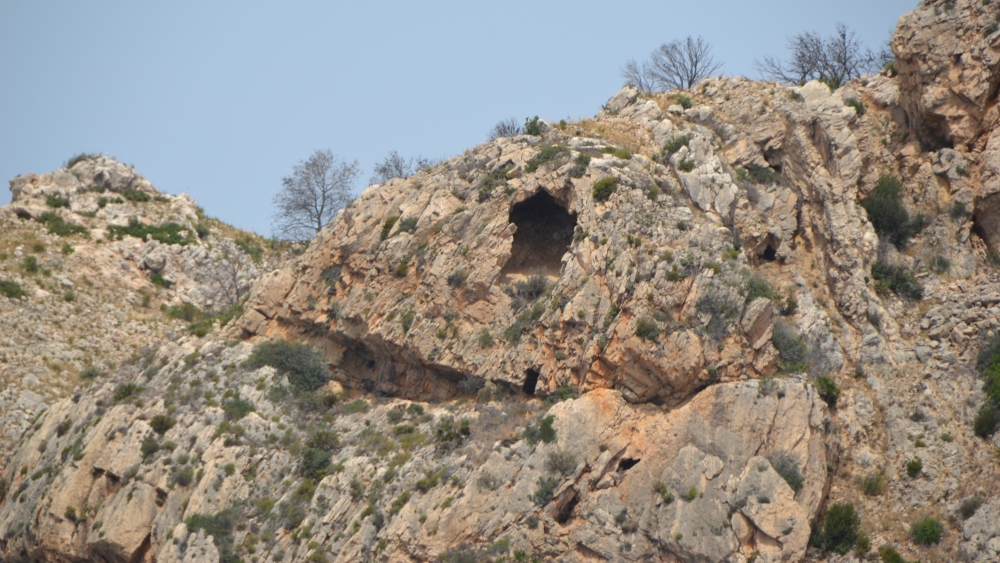
The caves are also under the protection of BIC (Bien de Interés Cultural) status, due to evidence of Bronze Age cave paintings. This designation, meaning “Asset of Cultural Interest,” is granted to sites of historic, artistic, archaeological, ethnographic, or paleontological value, ensuring the highest level of legal protection under current legislation.
Today, visitors can reach the caves via a narrow path that winds down the cliff face, a journey not for the faint of heart. With waves crashing against the rocks far below, a single slip could prove fatal, making the path as thrilling as it is awe-inspiring.
The Watchtower
In the 16th century, the threat of Barbary pirate raids prompted the construction of a watchtower at Cabo de San Antonio, part of a network along the coast to provide early warnings to nearby settlements. Completed around 1578 during the reign of Felipe II, it also served as a refuge for monks and as a strategic lookout. The tower remained in good condition for centuries, but in 1862 it was demolished to repurpose its stone blocks for the construction of the current lighthouse. This transition marked a shift from coastal defense to maritime navigation, turning the site into the beacon it is today.
The Cabo de San Antonio watchtower was part of a coordinated system that included the Torre del Gerro in Dénia, about 4 kilometres away, and the Torre del Portitxol, some 5 kilometres south near Cap Prim. These towers were positioned to maintain visual contact with each other, forming a continuous coastal line. Guards stationed in each tower would watch for approaching vessels and relay information using fires, smoke signals, or reflective mirrors, quickly sending warnings along the coast. This allowed nearby settlements to prepare defenses or evacuate if necessary, creating a rapid-response system against piracy.
The Lighthouse
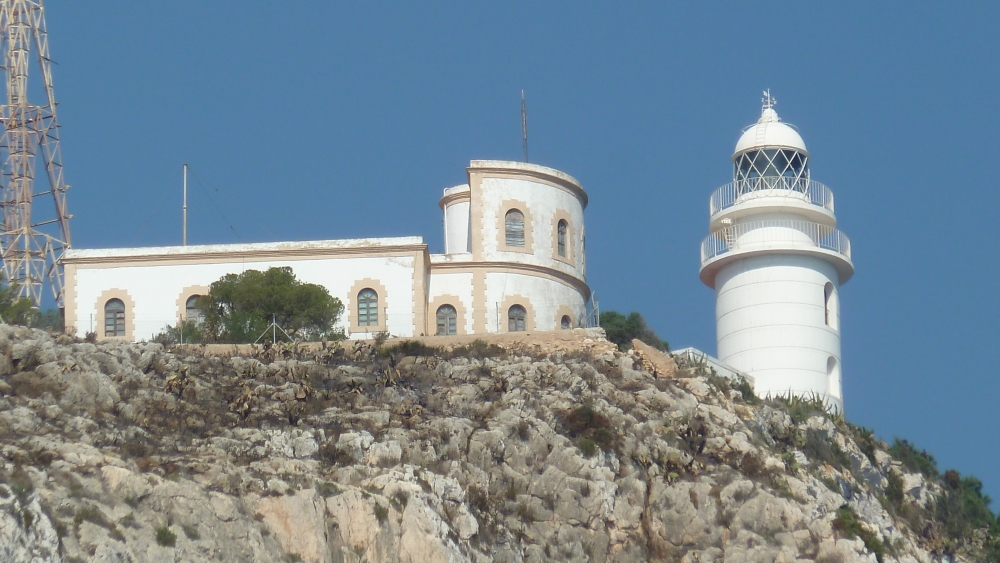
The Cabo de San Antonio Lighthouse sits 175 meters above the Mediterranean and has guided sailors along the Costa Blanca for over 150 years. It has undergone several major technological upgrades since its initial illumination. Originally, it operated with an olive oil lamp and a 2nd-order rotating apparatus producing white light eclipses every 30 seconds, visible up to 19 nautical miles. Soon after, a shadow zone affecting navigation prompted the lighthouse to be rebuilt at the tip of the cape in 1861, temporarily extinguishing the light. Later enhancements included petroleum vapor incandescence in 1914, and in 1926, the introduction of a four-flash characteristic, with the optical system redesigned for a new rotating mechanism.
After a brief shutdown during the Spanish Civil War, the lighthouse continued operating until the 1960s, when it was fully electrified and modernized. Renovations from 1962 replaced the lantern, rotation mechanism, lamps, and optics, and by May 1967, low- and high-voltage electrification lines had been installed, supplying all facilities at the lighthouse with modern power.
On February 26, 1863, a lightning strike hit the kerosene-powered tower during a fierce storm. The bolt entered through a window, destroying the staircase and parts of the building. The keeper, initially injured in the arm, would later succumb to his injuries, a stark reminder of the perilous life of those who kept the light burning.
Today, the lighthouse is unmanned, but plans for the complex remain for its future. A visitor centre for the San Antonio Marine Reserve had been proposed, which also saved the lighthouse from a private hotel conversion. The State Port Authority had leased the complex to the local council, and the previous municipal government, headed by the socialists PSOE, had drawn up plans ready to go out to tender in 2020. However, in 2024, the new local government, a tripartite led by the PP, decided not to develop the centre at the lighthouse due to what they claimed was a high projected budget of 1.4 million euros, adding that they had other priorities. Instead, they proposed relocating the visitor centre to municipal land at the Xàbia shooting range which lies further inland whilst also maintaining the intention to open up the lighthouse to the public.
The Viewpoints
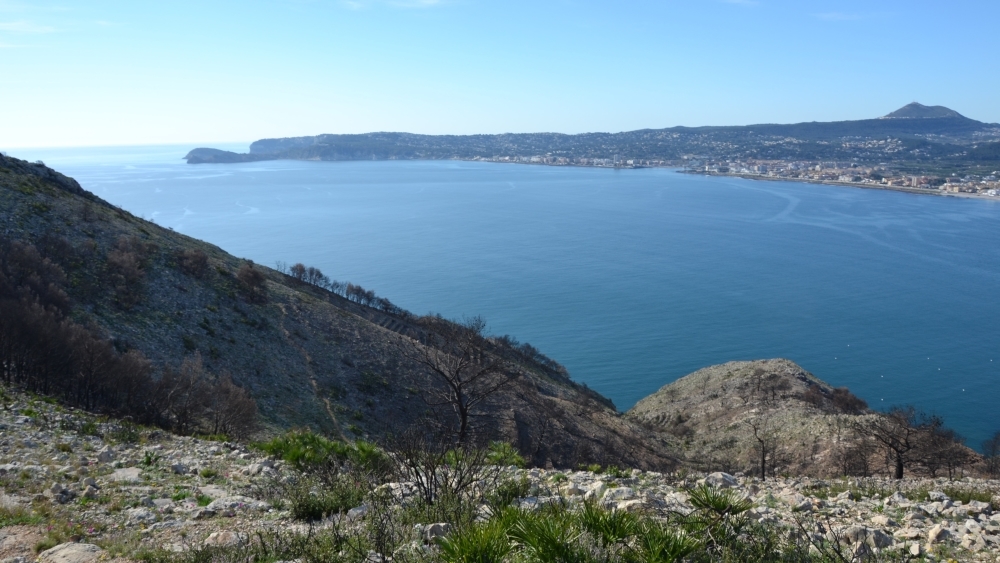
Several easily accessible viewpoints lie close to the lighthouse, all offering spectacular vistas across the bay of Xàbia, where the turquoise water curls around the town below. The main viewpoint is located right next to the road with a car-park that has recently been a popular but illegal overnight spot for motor caravans. The second viewpoint lies a short walk away, through a set of gates, to a flat platform where the hermitage and watchtower once stood. On the night of September 8th, this is a popular spot from which to watch the fireworks which bring the end of the fiestas in honour of the Virgen del Loreto to an end. From this spot, a narrow path winds down into the port.
A third viewpoint, perhaps the most endearing, lies to the immediate south of the lighthouse complex, through an open gate, which provides an even wider view of the bay of Jávea. From this point, those with a head for heights can pick their way through the rocks to reach a spot at the very end of the headland, where the stone wall of the complex disappears over the edge.
A short walk north from the lighthouse car park a little further up the road rewards visitors with a breathtaking view north over the wide Gulf of Valencia, west along the steep north flanks of the headland, and on an exceptionally clear day, the island of Ibiza, around 90 kilometres away, can be glimpsed shimmering on the horizon.
Cabo de San Antonio today is celebrated as a “privileged” sanctuary, both for its natural beauty and its rich biodiversity, while only a few stone remnants hint at its past structures. Xàbia continues to honour Sor Basota: a street in the historic centre bears her name, and the church of Nuestra Señora de Loreto in Duanes de la Mar houses her sarcophagus, a quiet reminder of a woman whose devotion shaped this scenic corner of the Costa Blanca.