
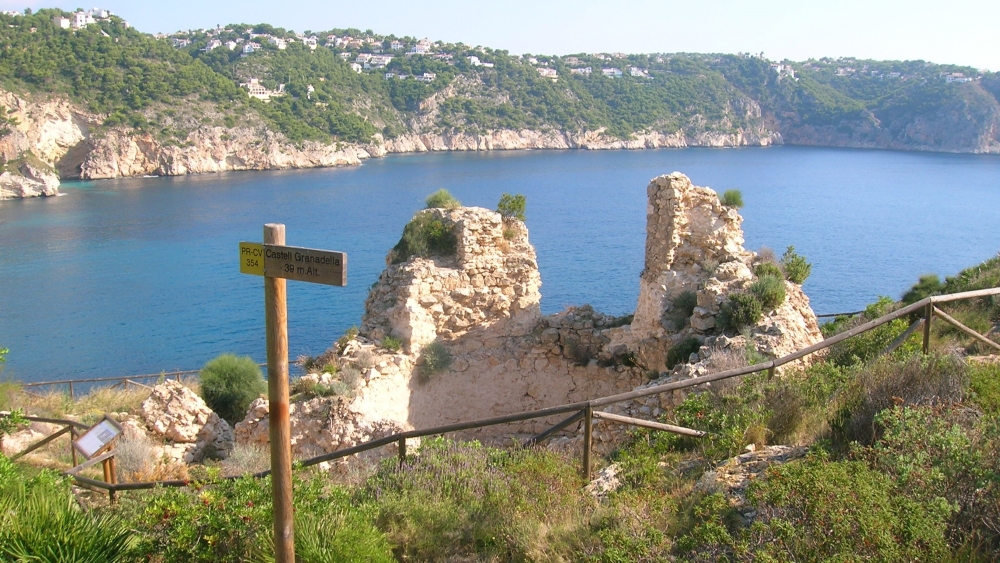
Castell de la Granadella occupies a strategic headland on Xàbia’s southern coast. Constructed in the early 18th century as a small coastal battery against Barbary piracy, the ruins speak of a long-gone fortification that exemplified austere military architecture: compact accommodation for a handful of soldiers, embrasures for observation and small-calibre guns, and a vaulted cistern to supply water. Although modest in scale, the site was an integral node in the Valencian coastal network of watchtowers and remains an important physical record of coastal defence strategies and daily life at sea’s edge.
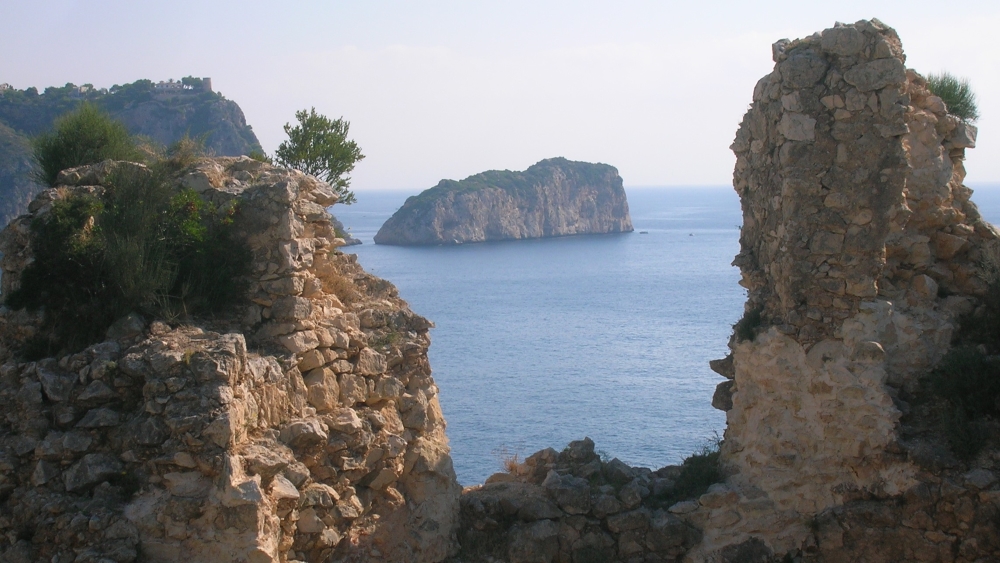
Perched on the headland that marks the southernmost point of Xàbia’s coast, the ruins command a sweeping view over the sheltered Cala de la Granadella. But the cove’s deceptively calm waters mask what was once a treacherous shoreline where corsairs and pirates turned every passage into a risk, the very threats this fort was built to deter. Today the site is hushed, but the landscape keeps speaking: low, weathered stone walls stitch the promontory together and the ruined vaulted cistern still testifies to the practical care that sustained small garrisons. From this high vantage the panorama extends from the curve of the cove out to the open sea, and the visual links that once relayed warnings to neighbouring watchposts remain eerily intact.
Although the surviving fabric dates to the early 18th century, it likely occupies the footprint of an earlier outpost. Archaeological finds, including fragments of glazed pottery from the mid 14th century, suggest earlier human activity and possible use during the region’s Muslim period, although no definitive evidence has been found for a substantial Moorish fortress on the site. The structure visible today is clearly a product of the 1730s, built as one of the Valencian coast’s small defensive batteries against Barbary pirate raids and positioned to maintain visual contact with Torre d’Ambolo to the north and Torre del Descubridor on Moraira’s Cap d’Or to the south.
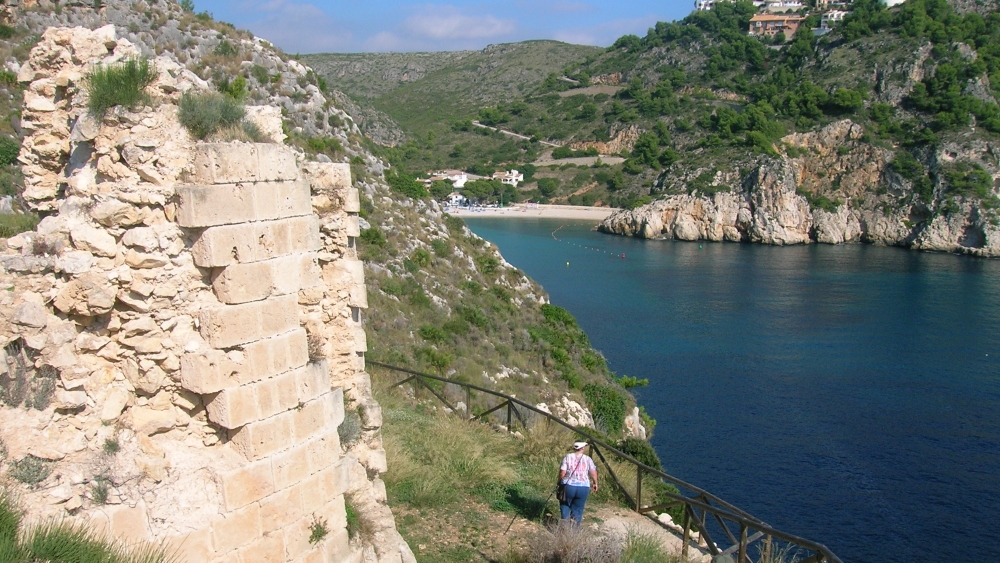
Perched 40 metres above the sea, the current structure was completed around 1739. Its roughly horseshoe plan, reminiscent of that which sits on the coast of Moraira, was built to house a small garrison and two bronze cannons pointing out to sea. The forward walls, up to 2 metres thick at the base, tapering to 1.5 metres at the crest and reaching as high as 17 metres, flared outward to create a sweeping arc of fire across the bay. The landward side was defended by a shallow moat crossed originally by a retractable bridge or perhaps a winding rope ladder. Externally the rough masonry was clad in tosca stone bricks, some of which remain, and which were mostly laid horizontally with occasional vertical bonding stones for added strength.
Access to the fort was via a small door set high in the rear wall, reached originally by a rope ladder. Inside, three levels were linked by a spiral staircase of which only three steps survive. The lower chamber served as storage for ammunition and provisions, while the upper room had five small openings facing the sea and another five facing inland, allowing the garrison to watch both the cove and the open water. The flat roof mounted two bronze cannons. A nearby vaulted cistern, holding roughly 23,600 litres, provided the garrison with precious fresh water.
Perched for surveillance rather than domination, Castell de la Granadella functioned as a modest coastal redoubt rather than a grand fortress. In peacetime it was manned by just three sentries. In September 1779 those men watched helplessly as North African raiders attacked two Catalan vessels off the coast, forcing them to take refuge in Cala de la Granadella; the tower could not intervene because its cannon had been dismounted and were unusable.
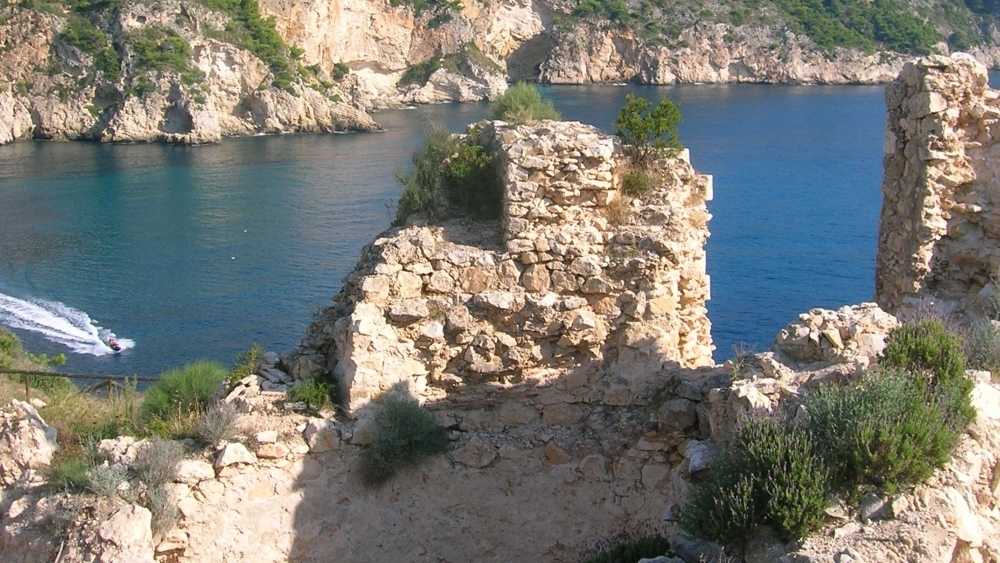
Barbary pirate attacks on the Valencian coast were part of a wider, long-running pattern of corsair activity from North Africa that intensified from the 16th century and peaked in the 17th century, when Ottoman‑aligned ports such as Algiers, Tunis and Tripoli became bases for slave‑taking raids, ship seizures and coastal roads against Spain, Italy and other Mediterranean shores. These raids were driven by a mix of economic incentive (prize and slave-taking), political patronage and naval opportunity: corsairs operated as privateers under local rulers or Ottoman authorities, striking lightly defended coasts, exploiting seasonal winds and prowling trade routes for vulnerable merchants and isolated settlements. The threat persisted into the 18th century, prompting the construction of watchtowers and small coastal batteries along the Valencian coast, but by the early‑to‑mid 19th century, sustained European naval campaigns, changing diplomatic pressures and the gradual collapse of Barbary state power sharply reduced corsair activity and brought the era of regular raids to an end.
As a result, Spain’s coastal defences were reorganized and many small fortifications were made redundant or intentionally demolished. Castell de la Granadella was probably mined by British forces in the early 19th century to deny it to the French during the Napoleonic War, a fate paralleled at Moraira (the fortress is now fully-restored) and at the long-vanished castle of Fontana that once guarded Arenal bay. Thereafter the tower surrendered slowly to erosion, scrub and the relentless sea wind that scours its ramparts.
In the early 21st century Xàbia’s local council undertook archaeological investigations that unearthed substantial material, including a cache of cannonballs, and then began to adapt the promontory for visitors. Undergrowth that had nearly swallowed the ruins was cleared, guardrails were installed along the cliff edge and above the moat, and an information panel was placed on the landward approach. A narrow path now links the cove to the site, but there are no curated exhibits, the cannons have long disappeared, and the interior cannot be fully accessed. The interventions make the fortress and its purpose more understandable rather than offering a fully reconstructed site: it is a place to discover a fragment of Xàbia’s past while enjoying an intense coastal solitude, the hiss of wind through scrub, the crash of waves below, and the whisper of a history only partly recovered.
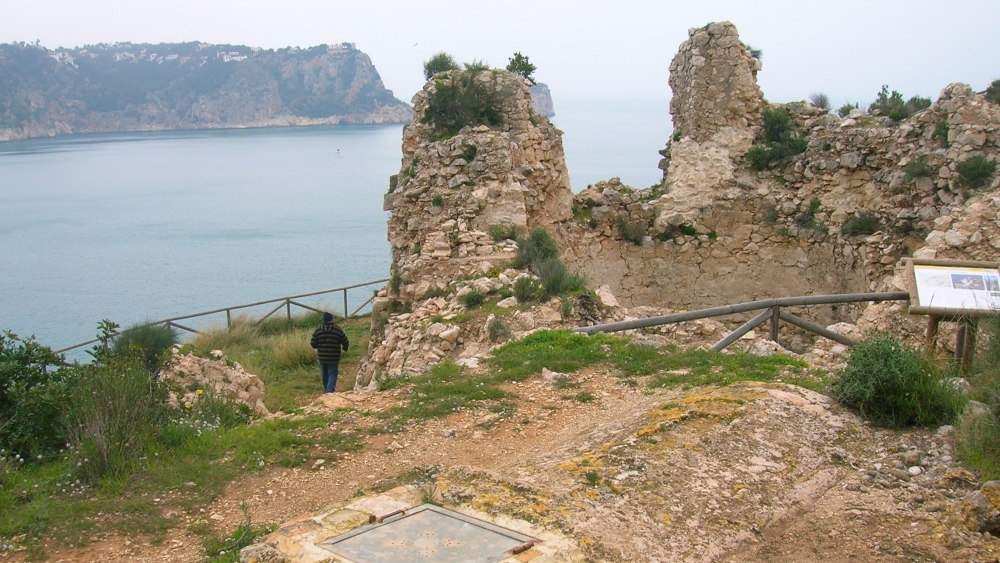
The ruins can only be accessed on foot. From Cala de la Granadella, the official trail PR-CV 354, well-marked by regular signposts, climbs 1.6 kilometres to the site. The route is graded medium and is not for the faint-hearted: at times it clings to the cliff edge and negotiates short rock scrambles where anchored chains offer security and help you pull yourself up. It winds through fragrant Mediterranean scrub and umbrella pines, following the cliff contours until the ruins suddenly appear, crouched above the sea. From the headland the panorama is exceptional, north over the bay’s crystalline waters, east toward Cabo de la Nao, and beyond that the vast blue of the Mediterranean.
The return re-traces the cliff path back to Cala de la Granadella. For those with energy and surefootedness, an alternative route climbs from the ruins up the ridge to the Mirador de Llevant. The path gains steeply to about 180m and delivers dramatic, uninterrupted views: south along the razor-edge sea cliffs toward Moraira’s Cap d’Or and, on clear days, as far as Calp’s Peñon d’Ifach. The ridge route is wilder and more exposed than the castle access path and rewards effort with broader panoramas and a stronger sense of remoteness.
Castell de la Granadella endures as both ruin and monument, a small stronghold that once played an outsized role in coastal defence. Its ruins remind us that even modest sites mattered in the rhythms of war, trade, and watchfulness. Here, on the very edge of the Mediterranean, beauty and history coexist: windswept stone, a vault that still holds life-sustaining water, and panoramic sea-views that have witnessed danger and peace in equal measure.
Sources:
- Javea.com – “El Castell de la Granadella,” historical and archaeological overview.
- CastillosRicsol.es – “Castillo de la Granadella,” architectural details and state of conservation.
- CalaGranadella.com – background on the coastal defence network and 18th-century context.
- RestaurantTrencall.com – local tourism and historical summary of the fort’s garrison and artillery.
- Wikiloc.com – PR-CV 354 hiking route description and visitor observations.
- wikipedia.com – “Barbary Corsairs”, history
- visit-andalucia.com – “The Barbary Pirates Scourge of the Andalucian Coast”, history