One of Xàbia’s darkest and most haunting stories is the chilling murder of five-year-old Bartolomé Sendra at the hands of his stepmother, Úrsula Tachó, in 1920, a crime that has been seared into the town’s collective memory.
Úrsula, forever remembered as the notorious ‘La Criminala de Xàbia’, has inspired countless retellings. Books have traced her sinister path, a film has captured the shadow of her deeds, and even the town hall has orchestrated a theatrical guided tour along the port to mark the centenary of this grim chapter. Though every Xabiero knows her tale, outsiders who have made Xàbia their home are often unaware of the darkness that once lingered in its streets.
Below is an abridged account of the events, drawn from Bernat Capó’s 1986 book “La Criminala”, with additional details from Erika Reuss Galindo’s 2019 work “La Casa de la Criminala”, featured in the port fiesta book. A story of obsession, cruelty, and tragedy that still echoes through Xàbia a century later.
The wind howled over Xàbia’s cliffs, carrying the brine of the sea and the faint, restless scent of pine, but inside the modest home in Portitxol, a darker storm was brewing. Modesto Sendra, a devoted policeman guarding the coast against smugglers, had once known love. His wife, Leanor, bore him two children, only to die giving birth to the boy, Bartolomé. Alone, Modesto sent his children to relatives in distant villages, trying to quell the emptiness that lingered like a shadow in his heart. Then came Úrsula Tachó.
Úrsula was no ordinary woman. Pale, silent, prone to fits of anger, she had always been a loner, a child of storm clouds and isolation. Her parents saw Modesto as a lifeline, a chance for her to step into a “respectable” life. They married, and for a time, the household seemed ordinary. But the moment Bartolomé, a bright-eyed five-year-old, returned to live with them, the air shifted.
Úrsula’s gaze darkened. The boy’s laughter, the small gestures of affection he craved, became unbearable irritants. When he reached for a smile, he met only scorn. When her mother dared show him kindness, Úrsula’s screams pierced the walls like knives. And when Modesto returned from work, he endured his wife’s endless grievances while his stepson suffered in silence.
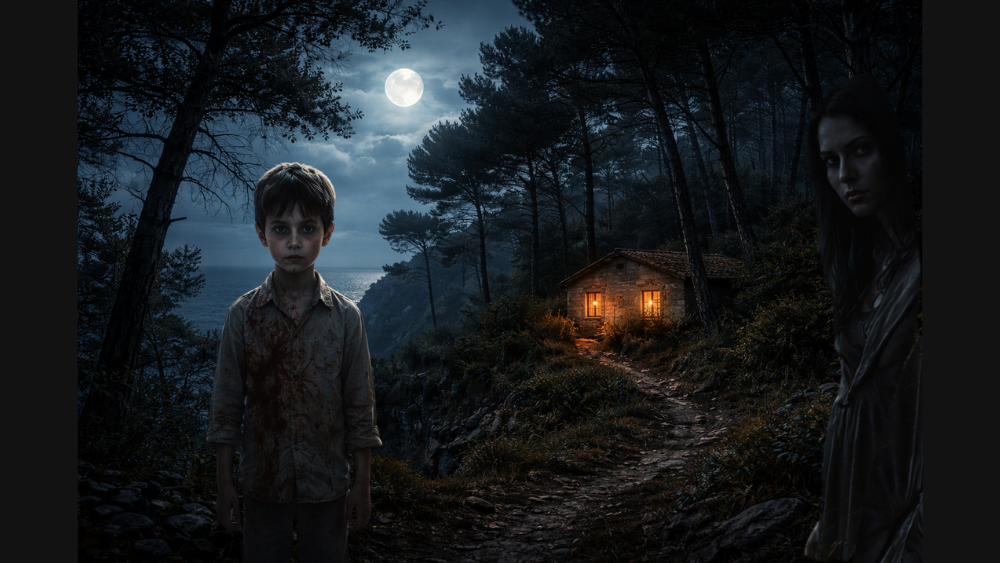
The first act of horror came under the pine-scented undergrowth of Cabo La Nao. Úrsula coaxed Bartolomé into the woods, whispering of herbs and games, and watched him vanish behind the trees. Then she walked home alone. When her mother inquired, she hissed, “I do not care,” retreating to her room to cradle her swelling belly, whispering to her unborn son that he would be the only one she would ever love.
The next morning, Bartolomé returned, clothes torn, limbs smeared with blood but alive. He washed quietly, a spectral image of innocence battered by cruelty. Úrsula froze, as if confronted by a ghost. Bartolomé cried for his father, and Modesto, weary from work, soothed him, unaware that the seeds of evil had already rooted themselves deep within his wife’s mind.
Her second attempt was more brazen. She sent him to fetch water from the well, shoved him into its shadowed depths, and fled in feigned horror. Fate intervened: the bucket caught on the pulley, and a passerby saved the boy. Úrsula raged, trembling, calling him a demon, but when he met her with accusing eyes, terror claimed her first.
Days later, she bore a son, Francisco, and decreed that Bartolomé must never approach him. Yet her obsession festered. Poisoned soup laced with shards of glass and match heads tested the boy’s resilience, night after night. Finally, one night, she struck with lethal precision, strangling him, piercing his eardrums with a knitting needle, and setting a cigarette ablaze on the mattress. She left him as smoke curled into the darkness, a young life extinguished in agony.
Modesto discovered the horror the next morning: Bartolomé, lifeless, wrapped in a blanket, eyes wide and staring as if gazing into eternity. He called for Úrsula, but she was gone, already in the custody of the Guardia Civil. The autopsy confirmed the nightmare: Bartolomé had been strangled, tortured, fed glass and flammable substances, a death both brutal and meticulously planned.
Úrsula was convicted and imprisoned for her crimes, but fate again played a cruel trick. In 1924, she was released under a general amnesty decreed by General Primo de Rivera. Briefly confined to a psychiatric hospital run by nuns, she emerged within months to live as the housekeeper of a wealthy man. Upon his death, she inherited his fortune and returned to Xàbia, rich, untouchable, and unrepentant.
Even then, her cruelty persisted. She employed two housekeepers, Josep and Remei, who endured her merciless temper and constant quarrels over unpaid wages. Promises of inheritance – should her son Francisco outlive them – meant little, for in Úrsula’s world, loyalty was a fragile illusion. Francisco himself, troubled and unstable, failed in his attempts to join the Guardia Civil. When Modesto died, a small pension intended for widows and orphans went to Francisco. Seeking independence, he purchased a horse and cart, but fate struck once more. On the way to a construction site, the overloaded cart collapsed, crushing his neck beneath its wheels. Whether Úrsula felt grief is unknown; her heart had long since hardened.
For Úrsula, the end drew near. Josep and Remei, weary of the social ostracism her name brought, resolved to leave. Confronted, Úrsula offered promises of money and inheritance, but her words carried no weight. Accusations and warnings followed, but later that day, her life ended abruptly. Josep, consumed by fury at her manipulations, seized a club and struck her at the back of the neck with such force that she fell, lifeless. Justice was swift: Josep was sentenced to thirty years in prison; Remei fled to France, returning decades later to live quietly until her death in 2016. Josep vanished into obscurity after serving his term.
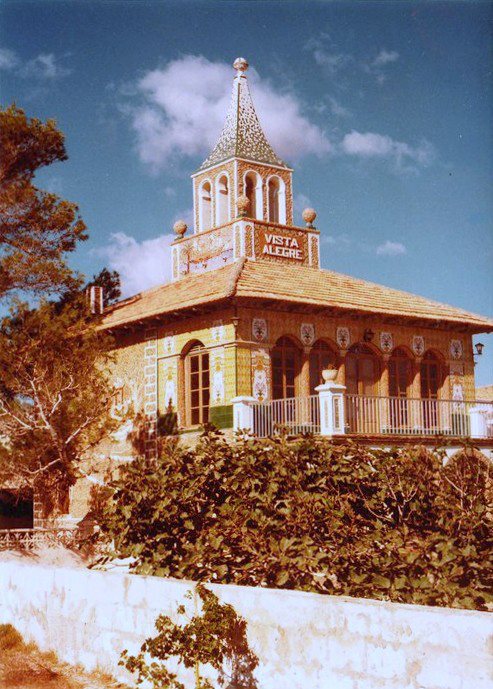
Vista Alegre, the lavish tiled chalet she had commissioned on the Primer Muntanyer, stood abandoned for years. Ghosts and rumours clung to its walls. Locals whispered of cries of a child echoing through the night, shadows moving where none should be. When the house was briefly converted into a cocktail bar named La Bruja, the weight of its past proved too great; the business failed. By the 1980s, the building was demolished, leaving only memory, rumor, and the chilling tale of a woman whose cruelty stretched beyond the grave.
Even now, the wind through Xàbia’s pines seems to whisper of her sins. The cliffs, the port, the undergrowth of Cabo La Nao, they remember the boy whose laughter was stolen, the sons who died under cruel fate, and the stepmother whose obsession became legend. In Xàbia, some things refuse to die, and some cries echo forever.