Researched and written by Mike Smith – February 2026
On the Third Sunday of Lent, the streets of Xàbia come alive with a quiet reverence. Dressed in their finest, the townspeople make their way up to the blue-domed chapel of Calvario to accompany the treasured images of Jesús Nazareno as it begin its journey down to the heart of the village. Hundreds of xabieros walk slowly along the winding Vía Crucis, led by young acolytes and carrying long candles that cast a warm, flickering light along the path. Some women go barefoot, a form of intense penance, fulfilling a vow to the town’s most cherished protector. Unlike the flamboyant processions of other fiestas, this descent is solemn, intimate, and profoundly moving—a highlight of the town’s religious calendar.
The fiestas honouring Jesús Nazareno are the oldest and most important religious celebrations in Xàbia, dating back to the second half of the 18th century, when the image was gifted to the town by the Duke and Duchess of Medinaceli. Housed in a chapel built specifically in its honour, the image became central to Semana Santa celebrations by 1768, though its original descent into the town was observed on May 3rd, the Day of the Holy Cross.
During the cholera epidemics of the 19th century, the surrounding Marina Alta region suffered devastating losses – but Xàbia remained untouched. The town’s faithful credited their treasured image with protection, an event considered miraculous, which only deepened the devotion. Over time, the procession evolved from a simple observance into the grandest celebration of the year, held annually from April 24th to May 3rd since 1886.
Weeks before the main festivities, the town demonstrates its devotion when the Brotherhood of the Nazarene carries the image from the iconic Calvario chapel to the fortress-church of San Bartolomé, at the heart of the historic centre. For the townspeople, this is a profoundly emotional moment, a ritual that reaffirms their faith and communal identity.
Since the late 19th century, the descent of the image has been observed on the Third Sunday of Lent. Its exact origins are unclear, but for over a century, the image would travel directly to San Bartolomé via the old Puerta del Mar. Recent safety concerns surrounding the structural integrity of the Casa dels Xolbi / Casa Candelaria forced a slight rerouting, yet the emotional impact remains unchanged.
On the day itself, families emerge after a long Sunday lunch to select their finest attire. Women choose demure dresses, men squeeze into rarely worn suits, and children tug at ties fastened by patient grandmothers. As the sun dips, early arrivals ascend to the chapel, where the Nazarene now rests in the centre of the nave. A hush falls over those waiting for a private moment with the image, while outside, men with loosened ties chat about those things that they like to chat about in between thoughtful draws on cigarettes. Even among skeptics, there is a shared acknowledgment of the moment’s sacredness.
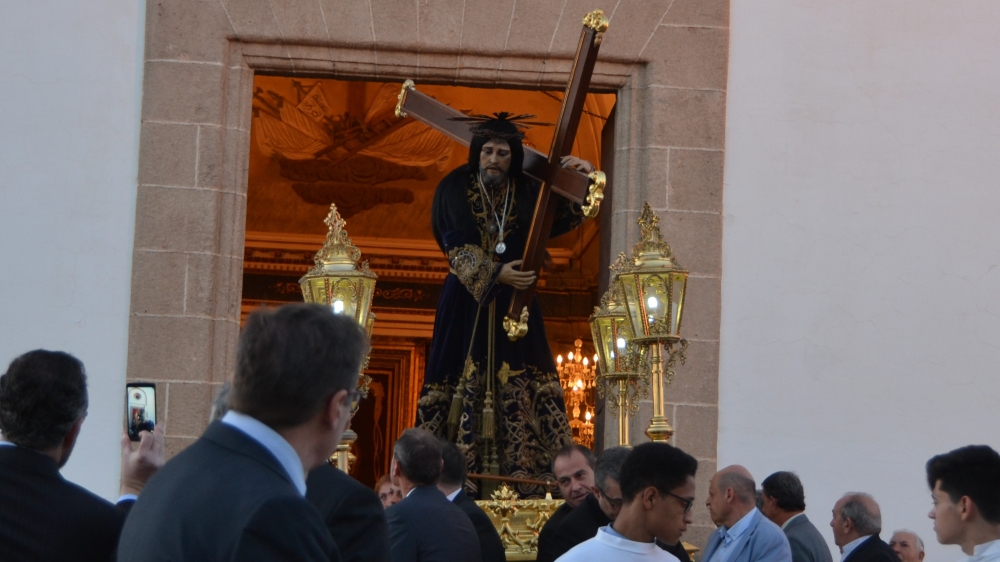
As the hour approaches, music heralds the procession. The town band ascends to the chapel, accompanied by municipal authorities and parish priests. More townspeople gather in the square, anticipation rippling through the crowd. First, the Brotherhood of the Holy Rosary carries La Dolorosa, the Virgin Mary, into the square. Heads bow in solemn respect. Then, to the swelling anthem of the band, the Nazarene emerges. The brotherhood bends low as the towering image clears the chapel doorway, lifting it onto their shoulders in unison.
Led by young acolytes, La Dolorosa sets the pace, followed by a band of the town’s youngest musicians. Candles light the way as the procession winds down the Vía Crucis, their glow warm against the early spring chill. Behind them, the Nazarene sways rhythmically to a familiar march, the image’s presence commanding attention as it moves through the shadowed pine-lined path.
A moment of tension arises at the tosca gateway, where the crowd halts, eager to witness the image pass through a door that barely allows it. The brotherhood adjusts carefully, the image tilting slightly, gasps punctuating the effort, until it safely clears the threshold. Mobile phones flash, photographers capture the scene, and the procession continues.
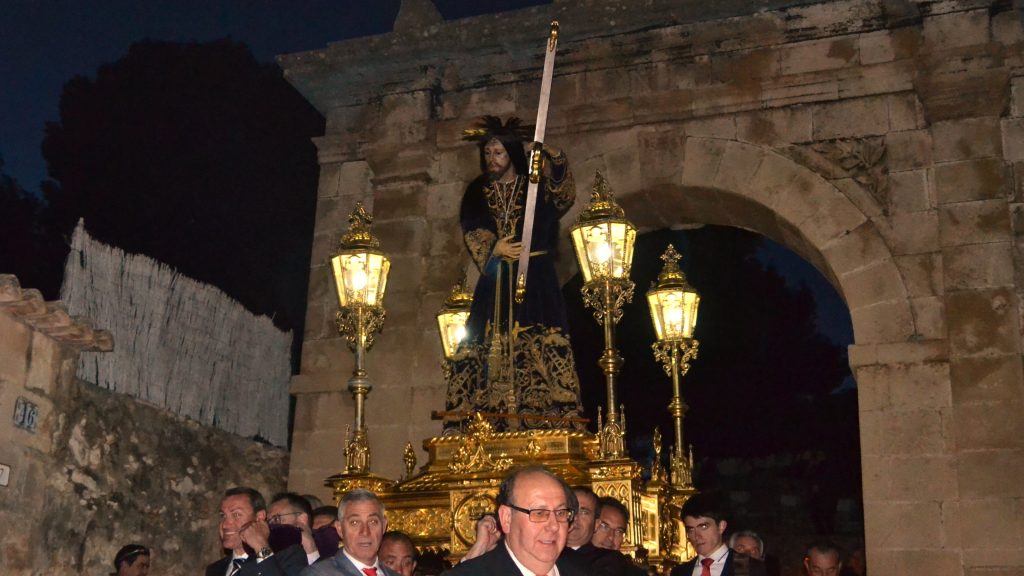
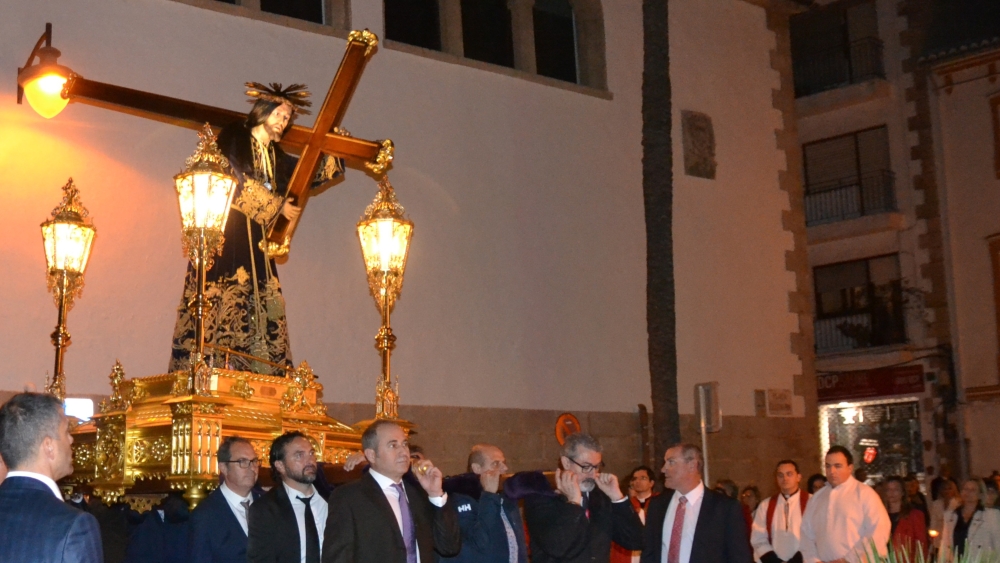
Descending the steep Camí Cañons, the brotherhood sets a measured pace, supported by fellow members. Traffic pauses respectfully, drivers waiting as the solemn parade winds around the roundabout. Along Carrer del Calvario, residents drape rich fabrics, heirloom shawls, and embroidered bedspreads from their balconies, some scattering rose petals in reverent celebration.
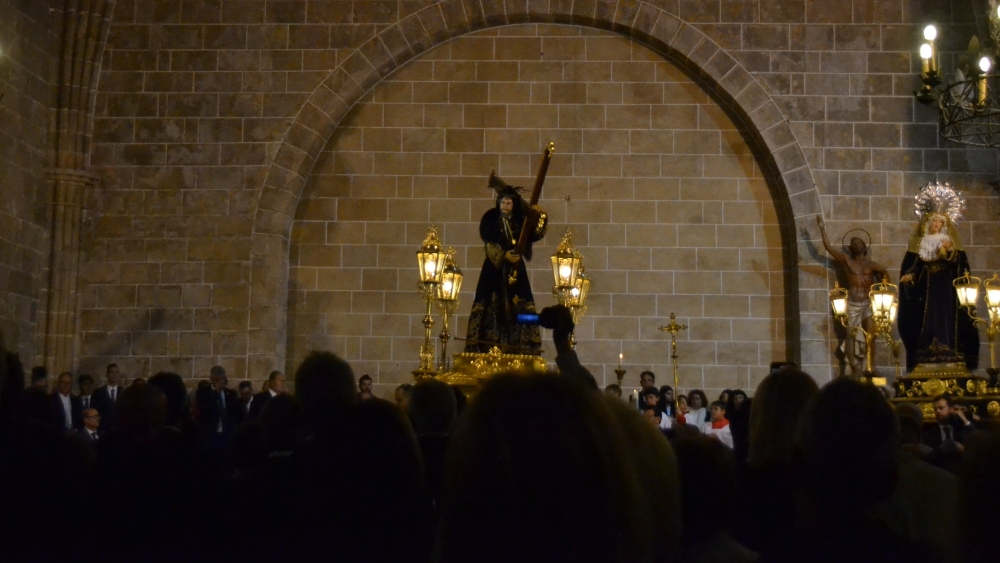
The church bells of San Bartolomé toll as the procession nears the historic centre. Inside, the church fills with those who did not accompany the images but wish to welcome them home. Standing room disappears; outside, the chill is forgotten in the warmth of communal devotion.
At the steps of the door opposite the town hall, called San Gil, the brotherhood manoeuvers carefully. Those not carrying the image gently move away the curious who are standing at the top for they need as much room as possible. La Dolorosa is lowered and carried into the apse, followed by the Nazarene. Once again, the image is carefully tipped to clear the low doorway. Fireworks burst overhead, the town band plays the overture, and applause erupts as the images pass through. With one final lift, the Nazarene stands at the front of the church, awaiting the celebrations of May 3rd. The descent is complete, and Xàbia turns toward spring and the approaching Easter festivities.