
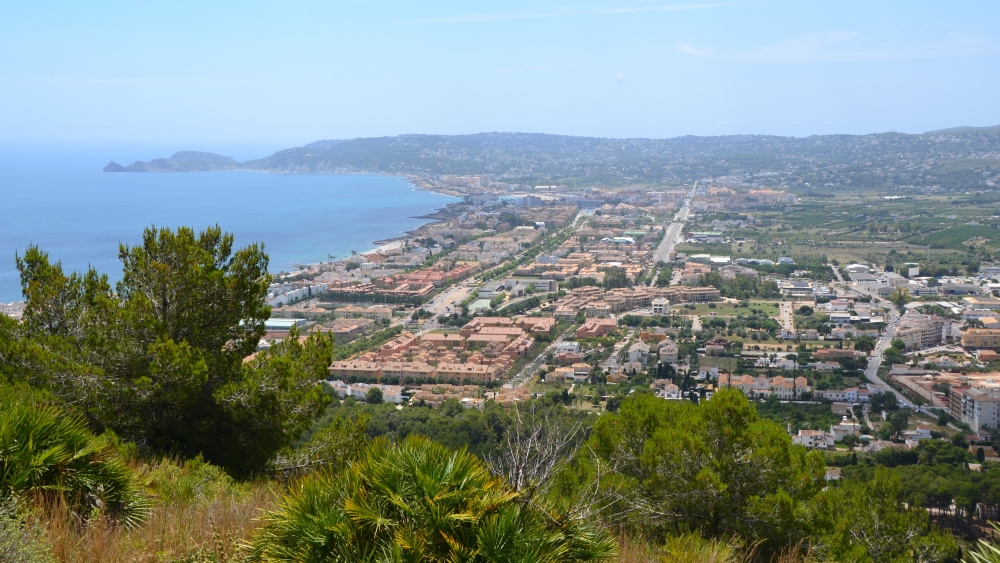
The view is stunning, the vast valley stretching out into the distance towards the low hills of El Rebaldí and Les Capçades and the hulking mass of the Parque Forestal del la Granadella beyond. The urban mass hugs the coastline, edging slowly away from the water’s edge towards the vineyards and orange groves. Yachts slice elegantly through the Mediterranean, heading no doubt to the popular cove of La Barraca, several kilometres distant. It’s a magical place, one of quiet contemplation now, one where you can sit and take it all in. And if you close your eyes and feel that ever-present Llebeig wind blowing against your face, you can almost hear long-gone sails turning in the wind, a slow creak as a wooden spar catches a gust, a low, dull rumble as the millstone bites into grain, the whisper of bags of wheat shifting in the cool belly of one of the towers. Now mere shadows of what they once were, these stone towers remind us of a once-thriving agricultural heartbeat that powered the region from the 14th to the 18th century.
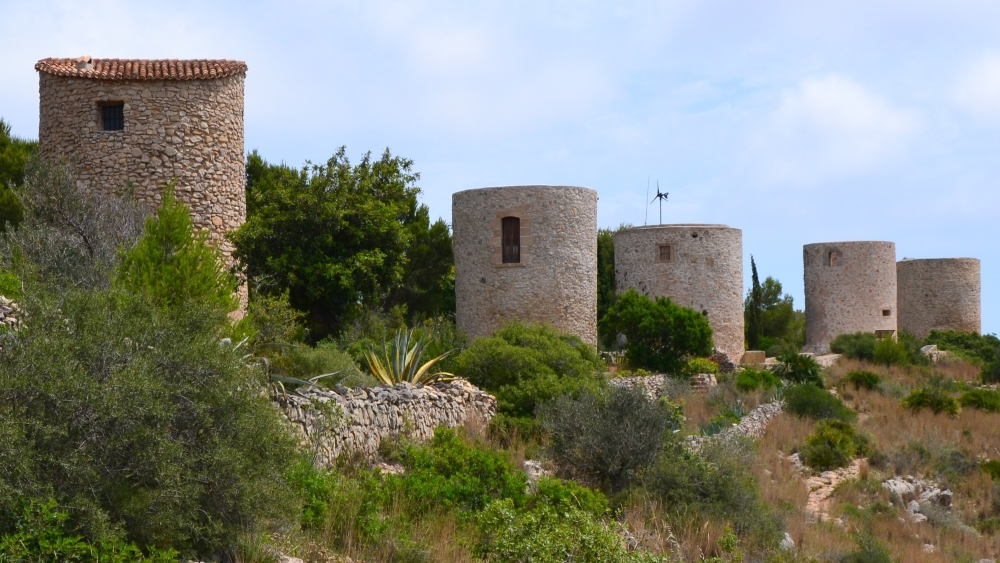
Perched on the edge of the high plateau of La Plana overlooking the valley, the clustered cylinders of Los Molinos de la Plana are considered as the largest set of flour mills in the Comunidad Valenciana, quite unique in the territory. They are not the remains of watchtowers, as some have considered in recent times, but rather they were built here to take advantage of the prevailing south-westerly – the llebeig – which blows almost constantly across the plateau, containing huge millstones rather than cannon or rifle. Today they are a popular stop on La Ruta de los Miradores de Xàbia, a collection of stunning viewpoints positioned along the coast.
Agriculture was the backbone of the economy of Xàbia in the 14th century. Wheat, vineyards, olives, and orchard crops dominated subsistence and local trade in the region and windmills were crucial for turning local cereal production into a marketable and storable product for domestic consumption and sale, sometimes charging for their use, another local revenue stream. At least one of them was used right up until the early 20th century and Vicent Ribes wrote of a visit in 1911: “I remember the mill of Tono Garçó; I must have been eight or nine years old. People came to grind from here and from Dénia and Els Poblets. The sails were canvas and we children were forbidden to go near them. The llebeig wind made them grind a lot and the noise of the millstones filled all of La Plana. In those years it was a procession of donkeys laden with wheat. La Plana was a bed of wheat and barley.”
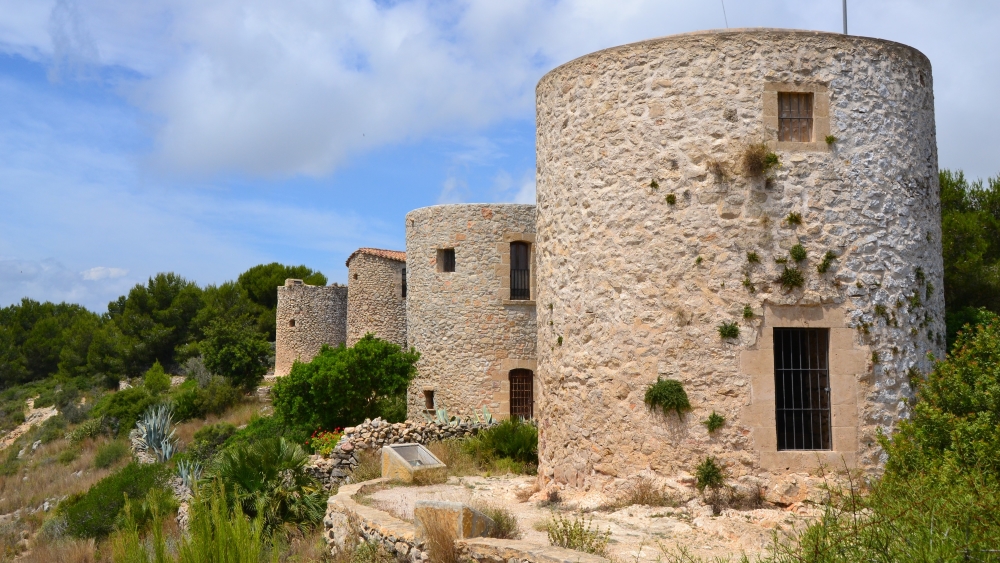
There are eleven windmills, lined up from southwest to northwest at about 190 metres above sea level on the edge of La Plana de Sant Jeroni. One dates from the 14th century and the others from the 18th. They take the form of large cylinders roughly seven metres high and six metres across. Each had two floors: the ground floor served as storage, while the upper floor housed the grinding. Between them there was usually an intermediate room, the miller’s living quarters. The top level was supported by a tosca stone vault that contained the wooden mechanisms, made from holm oak, that turned the millstones and carried the sails. All of this largely disappeared at the end of the 19th century, when they stopped operating as a consequence of industrialisation, the growing importance of the raisin trade, and the abandonment of wheat cultivation in the district.
Valencian author and historian Ferran Zurriaga i Agustí, in his 1990 book ‘La Plana. Terra del Llebeig’, notes that on some of the masonry you can still see marks and symbols that “had the symbolic value of sanctifying the building and freeing it from witchcraft.” Inside the mills, especially the one that appears oldest, there is a series of marks used to align the stones. Some, however, derive from the old signs of stonemasons or the secret marks of the stoneworkers’ guilds. If you take a closer look at the towers’ stonework you can still make out these inscriptions and tool-marks, which reveal both practical mason’s instructions and older symbolic carvings.
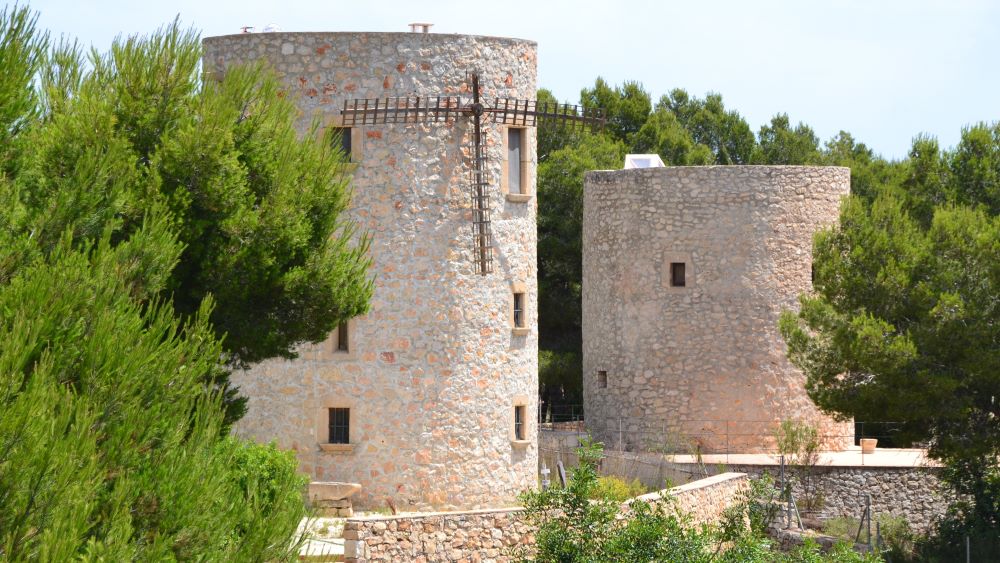
Today not all the mills are publicly owned; some are private and one of them even has a small two-tiered garden (the one that still has sails). Whether public or private, they are all classified as Assets of Local Relevance (BLR), the equivalent of being declared as a Listed Building in the UK, so they are protected, regulated and subject to controls. However, they are in the process of being declared Assets of Cultural Interest (BIC), the equivalent of a Cultural Heritage Site in the UK.
Conservation activity in the last fifteen years has been episodic rather than continuous. The municipal brigades and regional government funded and executed targeted rehabilitation projects (for example, work to consolidate and restore Mill No. 2 and emergency consolidation carried out on others in the early 2010s). Local associations, volunteers and owners have also participated in repairs and in raising awareness. But large-scale, comprehensive projects to restore all the mills into a unified visitor attraction or museum have not yet materialised.
Getting There – Car
Take the CV‑736 road out of Jávea toward Dénia, then turn right onto the CV‑7362 (Ctra. del Cap de Sant Antoni) and continue for just over a kilometre to the Santuario de Nuestra Señora de los Ángeles. If you’re feeling energetic you can park there and walk the 750 m to the windmills, a gentle uphill route along the Camí del Monestir. If not, turn right and drive up the narrow Camí del Monestir (mind those more energetic walkers) to a small rough car park at the end; there’s room for about half a dozen cars, and from there it’s a final 100 m or so on foot to the windmills and the views.
Be aware that the uneven path makes access very difficult for wheelchairs and prams.
Getting There – On Foot
There are two well‑used but demanding routes from the valley to the windmills for walkers with good energy and stamina.
- Molinos Variant (PR CV‑355) — difficult, steep
Starts at Carrer de Beniganím, which becomes a sometimes overgrown footpath that shortens the loop. It emerges on Carrer dels Puig Molins; turn right and follow the road nearly to its end. A narrow alley marked with white‑and‑yellow paint climbs steeply to the start of the main path up to the windmills. Lots of puff and effort and you will emerge at the car-park. - Longer, gentler alternative — scenic
Begins at the end of Carrer Azuebar in Puchol. The path skirts the western end of a bluff and eventually reaches Camí dels Molins. Follow the road up to the windmills, approaching from the opposite side of the car park. This route offers excellent views over the town, the hill of Santa Llúcia, and the majestic Montgó.
The Other Windmill
The Molí de la Safranera (the Saffron‑Maker’s Mill) stands apart from the La Plana windmills and is not part of that group. It is also a windmill, but is located in the Frechinal neighbourhood on Carrer Molí de la Safranera. Dated to 1850, it sits much lower than the La Plana mills, just 19 metres above sea level, and lies very close to the Gorgos riverbed. It is privately owned.
Sources:
- javea.com: LOS MOLINOS DE LA PLANA DE JÁVEA · https://www.javea.com/molinos-de-la-plana/
- Wikipedia: XÀBIA · https://en.wikipedia.org/wiki/X%C3%A0bia
- xabia.org: DESCUBRE XÀBIA · https://www.xabia.org/ver/1523/History.html